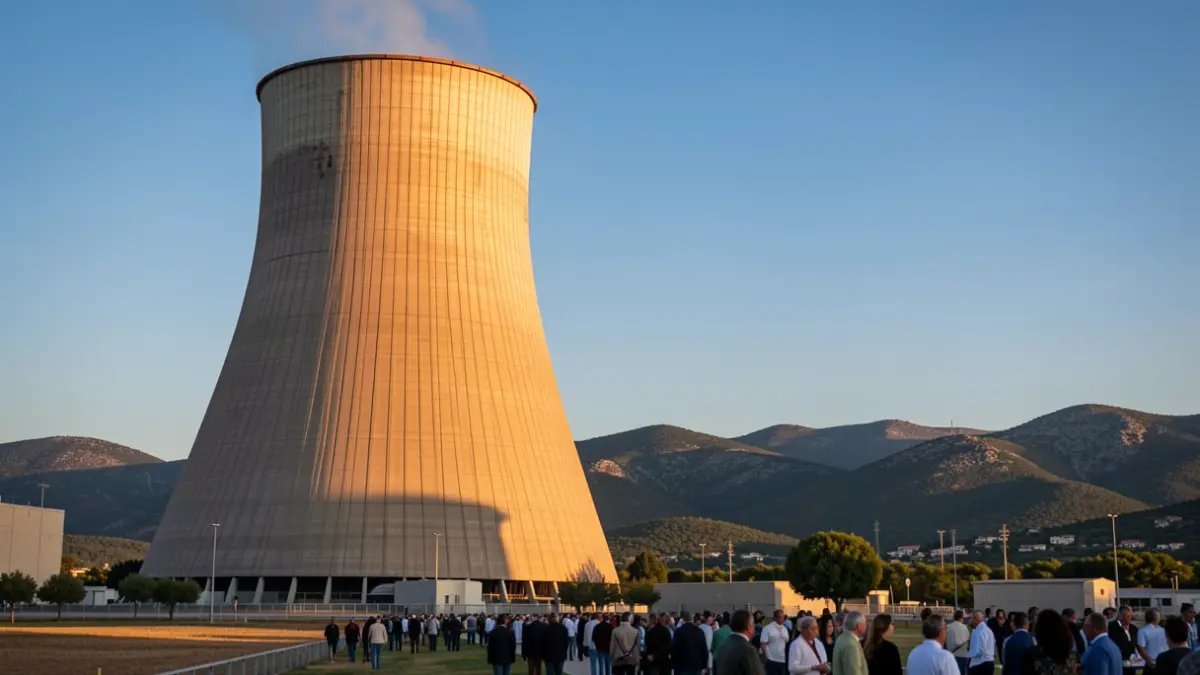
Facing the Spanish government's schedule for the closure of the Ascó reactors in 2032 and 2035, and Vandellòs II in 2035, the owning electricity companies assert their technical capability for safe operation over a longer period. This stance contrasts with environmental groups, who demand adherence to the schedule and warn against the nuclear sector's aim to socialize operational and waste management costs.
The nuclear industry is relying on economic and technical arguments to advocate for the continuation of the state's nuclear fleet, while the final decision on extending the life of the Almaraz nuclear power plant, slated to close in November 2027, remains pending. The conflict in the Middle East has doubled the cost of natural gas used by combined cycle plants, while uranium prices have remained stable, according to a Price Waterhouse Cooper (PWC) report.
According to the consultancy's calculations, the closure of a plant like Almaraz could increase electricity bills by 24% for households and SMEs, and by 35% for large companies in 2025, with an estimated total impact of 8.8 billion euros. In a scenario without nuclear power by 2035, the system would be more vulnerable to gas price fluctuations, with a projected increase of 22 euros/MWh during periods of geopolitical tension.
"Given geopolitical instability, the need for energy sovereignty, and climate challenges, the commitment to this technology is clear," stated Marta Ugalde, president of Foro Nuclear. She added that Spain must support the continuation of its seven nuclear plants, which, alongside renewables, are "essential and complementary" for a secure and sustainable energy system.
Foro Nuclear highlights that atomic reactors operated for more hours last year, contributing 19.05% of electricity. Globally, over 140 reactors are licensed to operate for 60 years, and plants similar to Almaraz could function for eight decades. The Nuclear Association Ascó-Vandellòs II (ANAV) declined to comment.
Nuclear communicator Alfredo García believes that plants can operate beyond 40 years, as this is a minimum period for investment amortization. He argues that plants require continuous investment in safety and equipment renewal, citing the United States as a benchmark, where many plants have licenses for 80 years. The Ascó I and Ascó II plants, which supply 60% of Catalonia's energy, would not need extraordinary investments but rather a continuation of existing ones.
García considers the Spanish government's plan to close nuclear plants a "very serious error," arguing that renewables, while necessary, "are not sufficient." He believes that maintaining natural gas capacity while closing nuclear plants is a transition energy mistake, as it involves replacing low-emission energy with high-emission energy, increasing costs and external dependency. He proposes that 30-35% of energy should come from nuclear and 65-70% from renewables.
Conversely, Ecologists in Action recalls that the closure schedule was a voluntary agreement with the electricity companies, driven by aging plants and declining profitability due to the rise of renewables. Their Energy Coordinator, Eloi Nolla, warns that the "nuclear lobby" seeks fixed prices and reduced waste management fees, effectively making the public pay operational costs. He likens extending nuclear plant lifespans to "playing Russian roulette," citing the accidents at Chernobyl, Fukushima, and Vandellòs I.
Nolla asserts that the energy system is prepared to replace nuclear power with renewables, which already constitute a significant portion of production. He notes that in Spain, atomic plants' share of electricity production has fallen from 20% to 9%, and in Catalonia from 80% to 50%. With installed renewables, electricity production could increase by 20%, yet many renewable sources must shut down due to grid saturation.
Finally, the environmental spokesperson mentioned that the debate on the Centralized Temporary Storage for nuclear waste is settled with individual storage facilities, but the project for a deep geological repository by 2072 remains pending concrete development.