
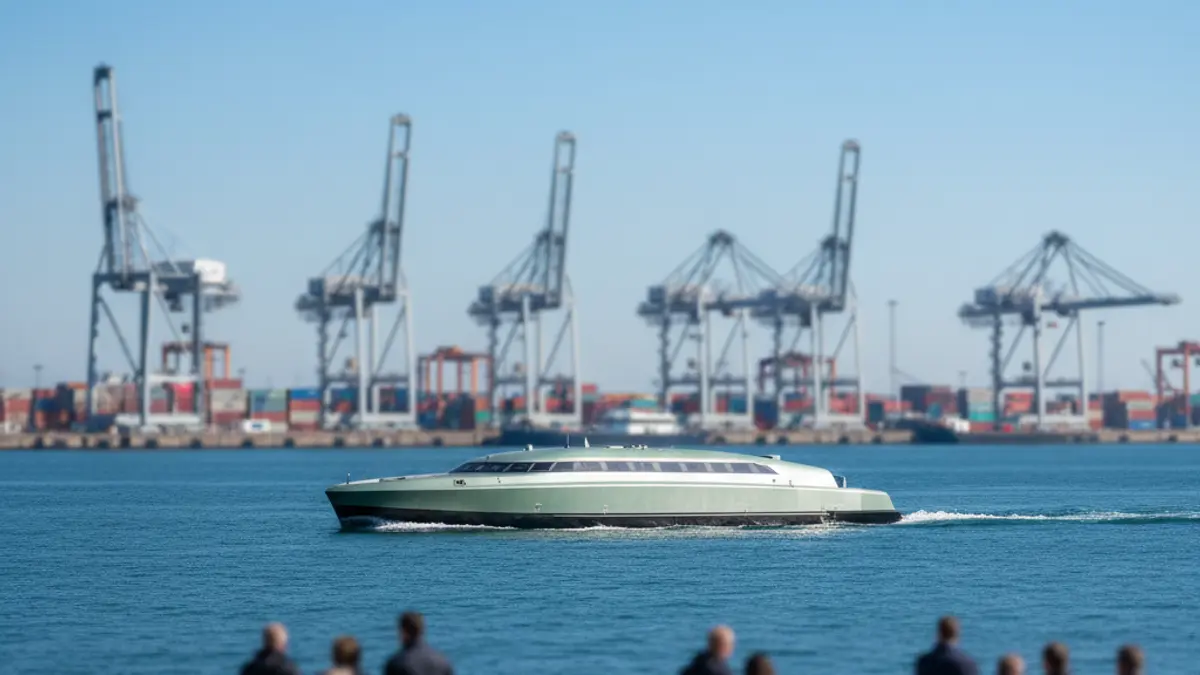
This striking green vessel, built in 2024 at the Vard shipyard in Norway, is currently docked at the León y Castillo Pier. Its design is focused on providing support to the offshore industry, carrying out marine prospecting and exploration tasks.
The vessel, which previously visited the port a year ago for repairs at Hidramar, will make a short stop to load 220 tons of diesel and conduct a crew transfer, as communicated to the Port Authority.
With a length of 85 meters and a beam of 16.4 meters, the Armada 86 01 can be operated by both onboard personnel and remotely. It boasts an autonomy of 21 to 35 days at sea, thanks to a 7,000-kilowatt hybrid propulsion system and two lithium-ion batteries.
This drone vessel is equipped to perform geophysical surveys, geotechnical inspections, sample collection, and maintenance services. Furthermore, it supports Ocean Infinity's fleet of remotely operated vehicles and autonomous submarines, facilitating the deployment of these craft via a removable stern deck.
“"These vessels are not a concept or an R&D project; they are already operational, transforming how offshore work is done by prioritizing software and technology."
The Armada 86 01 is one of 14 vessels that have joined Ocean Infinity's fleet since 2020, with the goal of redefining offshore operations. These vessels allow for a reduction in the number of personnel at sea, with capacity for 16 crew members, which also decreases fuel consumption and optimizes operational efficiency.
Among its advantages is the ability to perform tedious or highly technical tasks, such as bathymetry, hydrographic studies, and environmental measurements, as well as high-risk missions without endangering the crew. Additionally, all vessels in this class are prepared to use ammonia as fuel, one of the green solutions considered by the international maritime system.
The maritime sector has been one of the last to adopt remote-controlled vehicle technology. A professional meeting held at the Port of Las Palmas in late 2024 addressed the design of national certification for operating these vessels, responding to the new needs of the merchant navy. Although increasingly common, most of these ships are still used in fields such as Defense, surveillance, and scientific research.