
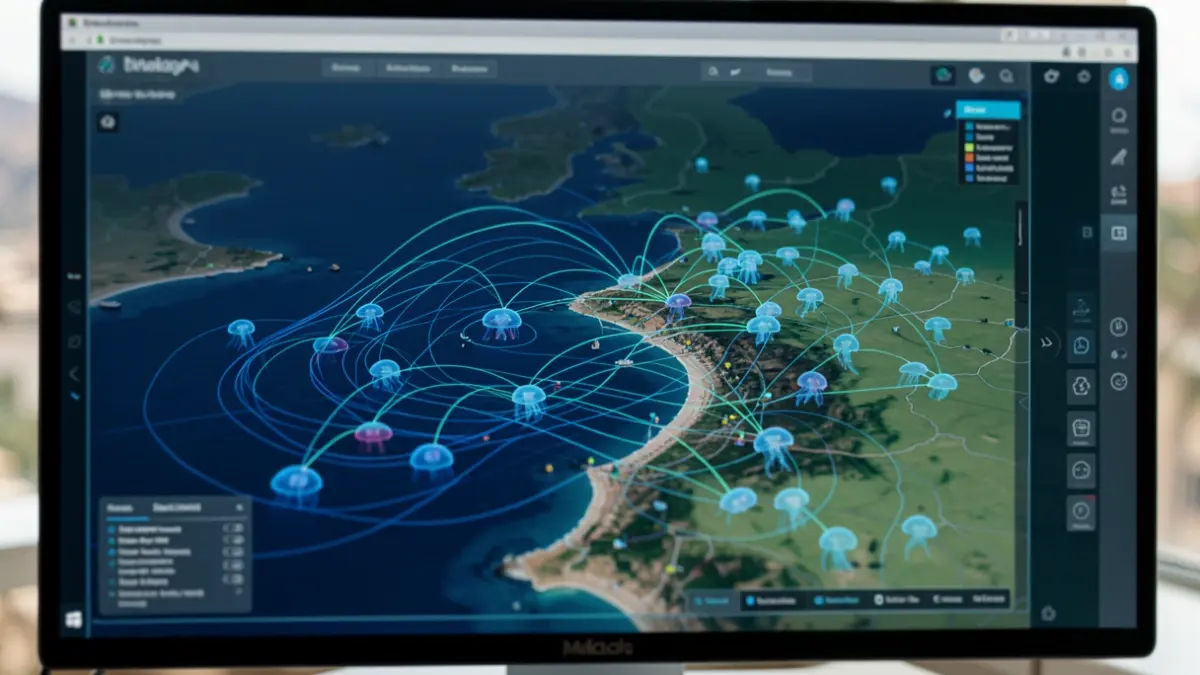
The coast of Málaga is benefiting from advanced technology to anticipate the presence of jellyfish, one of the most feared summer visitors. The Oceanaria Andalucía project has implemented a sophisticated artificial intelligence network capable of predicting marine currents up to five days in advance. This allows for alerts not only about the arrival of jellyfish swarms but also about the presence of plankton blooms or invasive algae.
This tool, at the forefront in Spain, enhances swimmer safety and represents a significant advancement for sustainability and the 'blue economy,' a concept gaining increasing relevance in the European Union's green policies. The Edanya research group, supported by the Junta de Andalucía and the University of Málaga (UMA), utilizes mathematical tools capable of calculating millions of possibilities regarding underwater current movements in minutes.
The platform combines traditional oceanographic information with satellite data to describe variables such as water temperature, wind direction, and marine currents. This enables the prediction of species like the "fried egg" jellyfish or others, facilitating the issuance of appropriate warnings. The algorithms generate a predictive map of beach conditions, useful for both beachgoers and municipal lifeguard and cleaning services, allowing for anticipation of algae or jellyfish accumulation at specific coastal points.
Jellyfish incidence has shown variability in recent years, influenced by changing weather patterns. Experts indicate that the Mediterranean Sea is experiencing an increase in jellyfish populations, attributed to climate change, pollution, and the overfishing of their natural predators, as explained by Francisco Franco, Doctor of Sciences and Director of the Costa del Sol Coastal Sciences Chair at the University of Málaga.
Although incidence has been irregular, with scenarios like 2024 where winds prevented significant swarms, previous years have seen the arrival of skin-irritating species such as 'pelagia noctiluca'. Last year, rising water temperatures and current shifts led to alerts due to the unusual and massive presence of dangerous species in municipalities like Marbella, Estepona, Benalmádena, and the capital Málaga. The Oceanaria Andalucía system not only displays predictive maps but also offers recommendations for water sports enthusiasts like surfers or divers, indicating wind and wave conditions in near real-time.
Andalucía is positioning itself at the international forefront of smart tourism. Instead of reacting to the unexpected arrival of swarms or microalgae accumulation, the system allows municipalities to plan lifeguard services and guide tourists towards safe bathing areas.