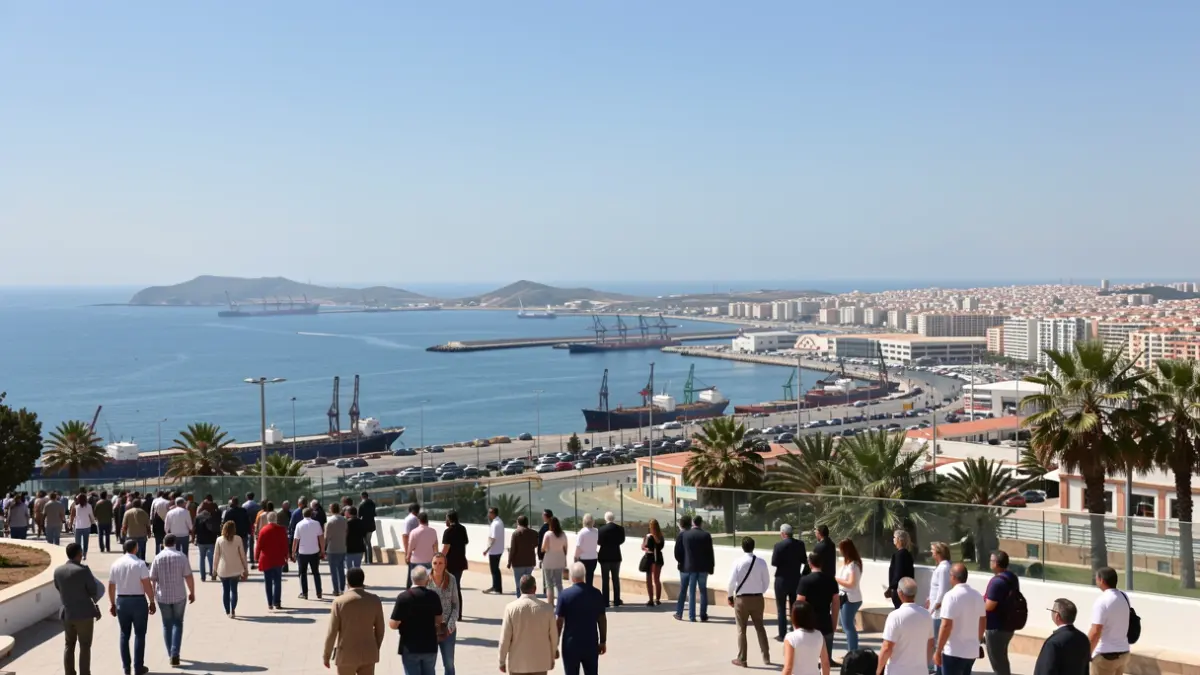
The socioeconomic dynamism of Campo de Gibraltar is reflected in its 24,859 total unemployed individuals across eight municipalities. This volume faces profound transformation with the imminent application of the agreement between the European Union and the United Kingdom regarding Gibraltar, considered crucial for La Línea and the region. In June, the area absorbed 913 workers, strengthening its productive fabric before the normalization of border crossings and customs reorganization.
The regional unemployment map shows the usual concentration in major hubs: Algeciras leads with 11,206 job seekers, followed by La Línea de la Concepción with 7,610, San Roque with 2,532, and Los Barrios with 1,819. In an intermediate tier is Tarifa with 841 unemployed, while Jimena de la Frontera records 485, Castellar de la Frontera 197, and San Martín del Tesorillo 169.
June's reactivation precedes a new legal framework. According to international law specialist, Professor Pablo Antonio Fernández Sánchez, Article 28 of the treaty stipulates the 'elimination of physical barriers' and the abolition of the historic Verja (border fence), streamlining the daily flow of cross-border workers.
However, the expert warns that neither the United Kingdom nor Gibraltar will become Schengen territory de iure. Their status will be that of an assimilated regime, similar to countries like Andorra, Norway, or San Marino, based on respect for the fundamental rights of the European Union and allowing for the potential re-establishment of controls for public order or health security reasons.
June's hiring was led by the region's two major labor engines. Algeciras reduced its lists by 457 people, and La Línea de la Concepción by 258. This statistical relief underpins the stability of a region where the census of cross-border workers—estimated between 12,000 and 15,000—constitutes a key asset of its financial, labor, and social profile.
The main macroeconomic challenge lies in the composition of job seeker lists, with the services sector accounting for 16,142 unemployed individuals. Article 29 of the treaty moves fixed Schengen and customs controls exclusively to the port and airport of the Rock, creating a specific passage that grants Gibraltarians an almost identical status to European citizens, ensuring free movement of people, capital, services, and goods.
This total commercial opening presents an extraordinary business horizon for the region's companies and self-employed, particularly in logistics and customs transport. However, to absorb this impact, the area must correct its imbalances, such as the high index of 4,103 individuals with No Prior Employment (S.E.A.), concentrated mainly in Algeciras (2,024) and La Línea (1,513), who will require immediate active insertion policies to capitalize on new synergies.