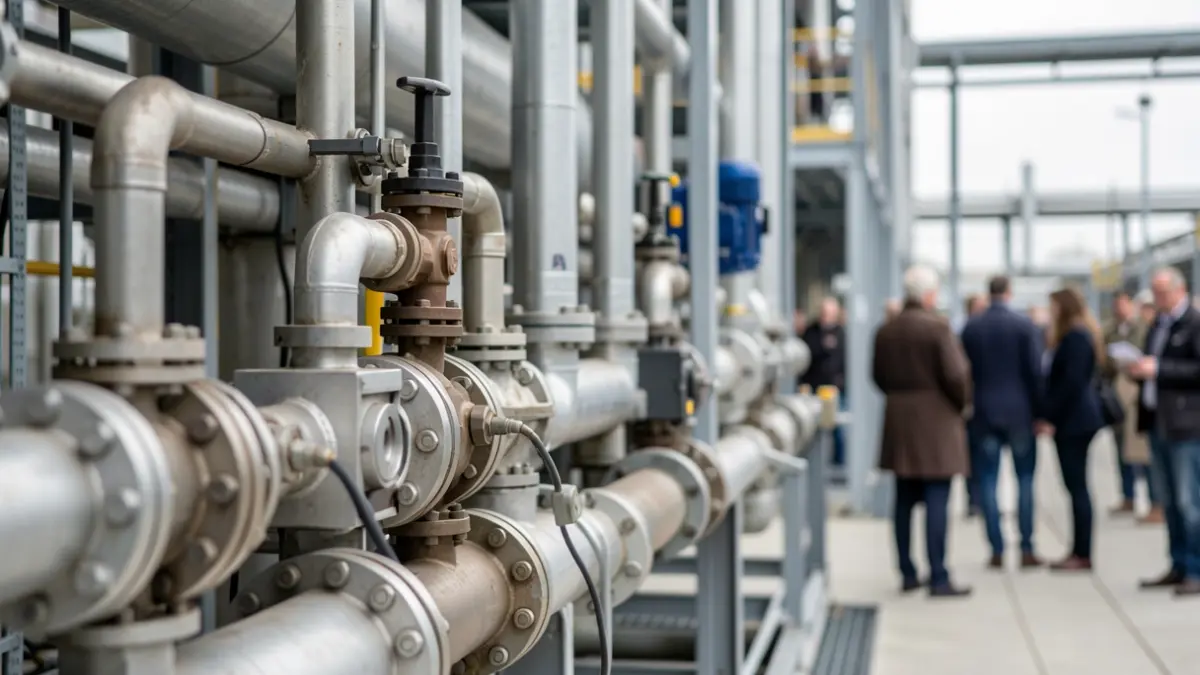
On September 30th, Ramón Barat, Professor of Environmental Technologies and head of the CALAGUA group at IIAMA-UPV, delivered the inaugural lecture for the «Second Transdisciplinary Meeting on Water Studies and Sustainability in Mexico: past, present, and future». The event, held in Mexico, focused on the evolution of wastewater treatment plants (WWTPs).
Under the title “How to transform WWTPs into biofactories”, Professor Barat detailed how these facilities can go beyond simple water treatment, becoming centers capable of recovering valuable nutrients and other resources for new uses. "This transformation presents new opportunities to connect purification with reuse and material recovery," the professor highlighted.
The concept of a biofactory integrates wastewater treatment with the valorization of its components, reinforcing the role of WWTPs in the circular economy. However, the timeline for achieving this model depends on the degree of recovery pursued. If a biorefinery is understood as a facility that valorizes all matter and recovers most of the nitrogen and phosphorus, there are still many years for this transformation to occur. Conversely, if the objective includes partial recovery of some of these resources, the horizon is closer. Therefore, specifying the scope of the transformation "is essential to assess progress and implementation timelines," stated Dr. Barat Baviera.
The transformation of WWTPs into biofactories requires integrating resource recovery processes with water treatment, ensuring the quality of the obtained products, and maintaining efficient facility operation. From an environmental perspective, the challenge is for this recovery to provide a global benefit, considering the energy consumption, emissions, and waste associated with new processes, in addition to preserving the quality of the treated water. The ultimate goal is to move towards a model that combines resource utilization with ecosystem protection.
Economic viability emerges as a decisive factor. Professor Barat distinguished three levels based on operating costs and investment recovery capacity: the first, where operating costs are equal to or lower than those of a conventional WWTP; the second, with zero costs or small profits; and the third, which requires generating sufficient profits to amortize the investment within a reasonable timeframe. Consequently, the future of treatment plants as biofactories will depend on both the degree of resource recovery and the chosen level of economic viability.