Valencian company King Marine, known for building high-performance carbon fiber racing yachts, has announced a strategic business reorientation. The goal is to expand its activities into technologically advanced sectors such as defense, space, and science, where the company believes it can generate significantly higher business volumes.
According to the firm's CEO, Pablo Santarsiero, the shipbuilding division is well-positioned and substantial growth in project quantity is not planned. The real opportunity for scaling lies in the defense, space, and science sectors, as these are areas where King Marine's differentiation is based on the quality and complexity of its production, rather than price.
King Marine currently operates two facilities in the province of Valencia: a factory in Alginet and its base at La Marina de València. The company's arrival in the region was initially for the 2007 America's Cup when Desafío Español required their services. Competition rules mandated that the boat be built in its country of origin, prompting the company, then based in Buenos Aires, to relocate, rent space, and produce in Valencia. After the regatta, the company decided to stay.
Gabriel Mariani, one of the founders, highlights the favorable environment they found: "The financing conditions, the supplier network left by the America's Cup, the locally trained workforce, the connectivity with the rest of Europe..." Over time, their Buenos Aires shipyard ceased production, making Valencia the heart of their operations. Pablo Santarsiero also emphasizes the ease of doing business within the European Union, as well as direct access to the sea.
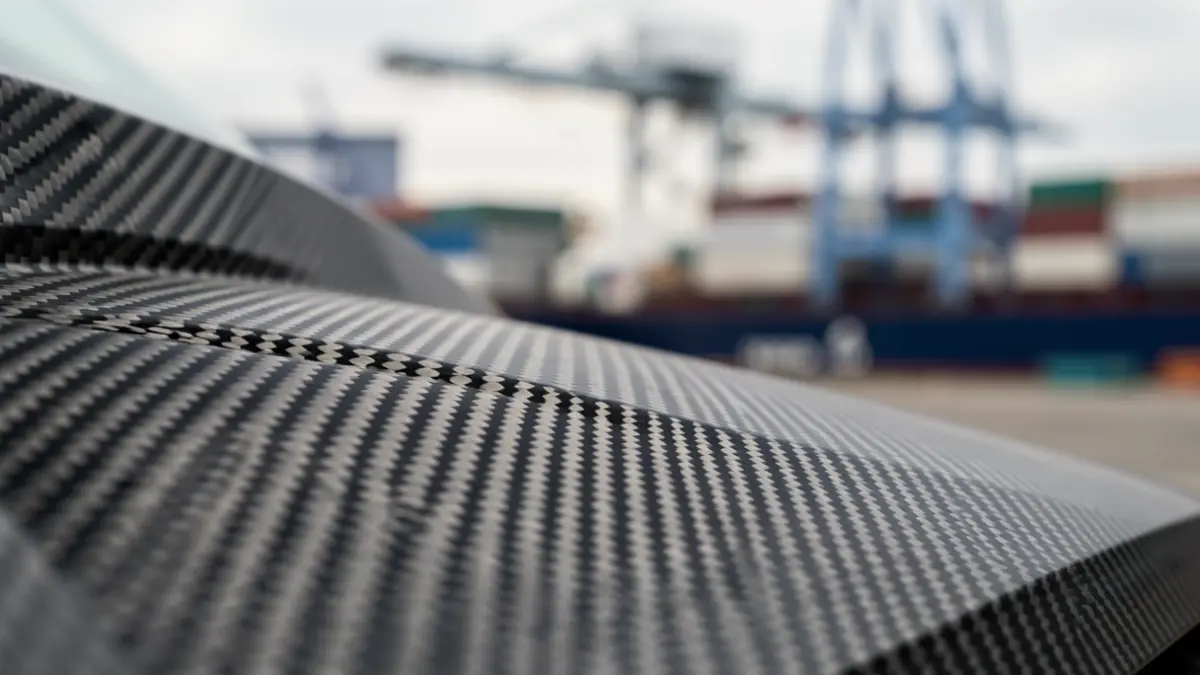
The company, which builds racing yachts for demanding international clients in regattas like The Ocean Race or the 52 Super Series, defines itself as a company that processes high-tech composite materials, specializing in prototype production. The treatment of carbon fiber, five times stronger than steel and resistant to oxidation and heat expansion, is the core of its activity. The freedom to experiment with this material, especially in regattas where event rules are the sole regulation, has allowed King Marine to accumulate unique expertise.
This capability has enabled King Marine to engage in sectors such as defense and aerospace. One of its first successes outside of sailing was King Agro, with carbon fiber agricultural spray booms, which was acquired by John Deere in 2018. Currently, the company manufactures radomes for defense programs, structures for scientific projects with zero error tolerance, and participates in the TANK2ZERO program for developing liquid hydrogen tanks for zero-emission aviation.
Santarsiero states that "carbon has a unique property that makes it ideal for these projects," highlighting its dimensional stability under extreme conditions. Organizational flexibility and adaptability have been key to the company's survival for twenty years, keeping them "alert" to project uncertainties.