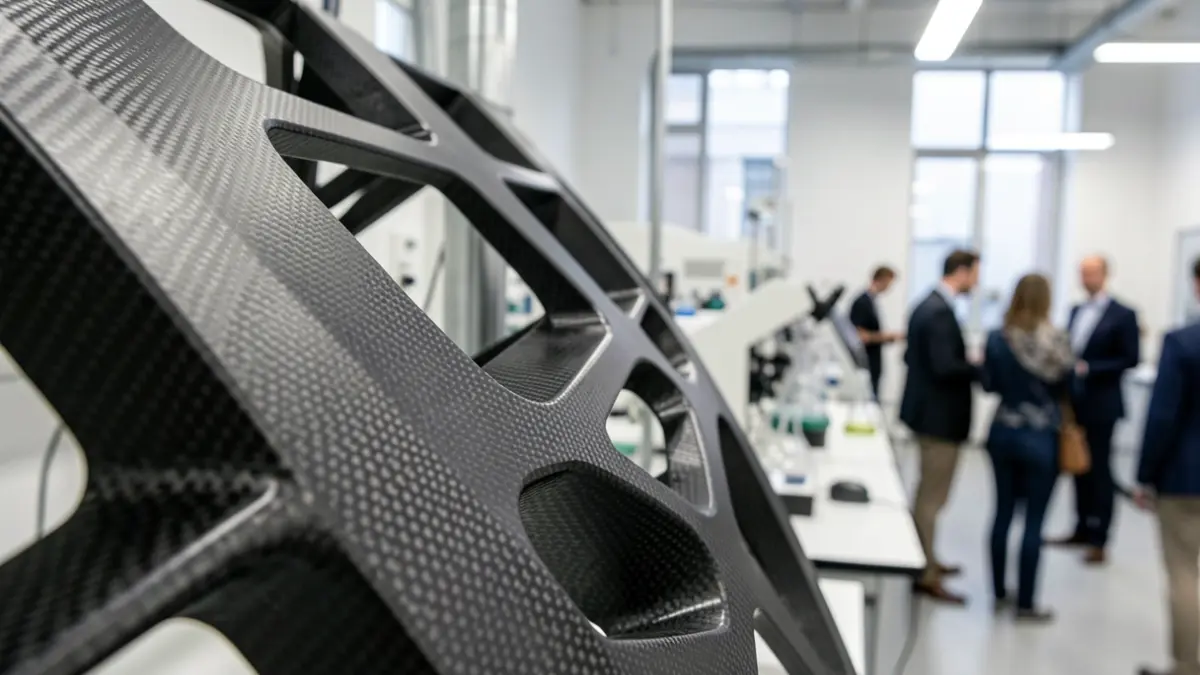
Reducing vehicle weight is a key strategy for improving energy efficiency and decreasing transport emissions. In this context, the European project FOREST, coordinated by AIMPLAS, the Plastics Technology Institute, has developed and validated new lightweight composite materials for applications in automotive, aeronautics, and collective transport. These new components achieve weight reductions of up to 35% compared to conventional ones, without compromising their performance, safety, or durability.
Project results demonstrate the possibility of developing transport components with over 50% sustainable materials. These combine bio-based raw materials, recycled carbon fiber, and functional additives, while maintaining performance, safety, and industrial viability. The final demonstrators have achieved weight reductions between 30% and 35%, meeting mechanical requirements, fire behavior, and, where necessary, electromagnetic shielding.
Material sustainability has been accompanied by improved manufacturing efficiency. Process optimization has reduced energy consumption by 15% to 25% thanks to accelerated curing chemistries that have shortened cycle times by 20% to 40%. Intermediate processes and freezer storage requirements have also been eliminated. Furthermore, engineering costs have been reduced by 15% to 20% through tooling simplification and increased process robustness.
“"FOREST demonstrates that sustainability, weight reduction, and safety are not incompatible goals. By integrating bio-based materials, recycled carbon fiber, and multifunctional properties, we are redefining advanced composite materials for the mobility of the future."
Coinciding with European Mobility Week (September 16-22), the FOREST project's advancements highlight the role of sustainable and lightweight composite materials in reducing energy consumption and emissions associated with future transport.
The project has designed, manufactured, and validated three demonstrators to test industrial viability in key sectors: an electric vehicle battery cover (with bio-benzoxazine matrix and recycled carbon fiber), an aircraft cabin roof panel (with organosheets reinforced with recycled carbon fiber and Bio-PA), and a pultruded profile for bus roofs (with recycled carbon fiber and Bio-PA).
Another major achievement has been the development and pilot-scale validation of three bio-based resin systems: a bio-acrylic resin (with approximately 25% bio-based content), a bio-benzoxazine resin (with 85-87% renewable carbon), and a bio-polyamide 6 (in partially and fully bio-based versions). These resins have met the requirements for the final demonstrators, improving bio-based content, processability, and performance.
The project has also promoted the valorization of carbon fiber waste, recovering up to 100% to transform it into high-quality semi-finished materials. The recovered fibers retain a significant proportion of their original mechanical properties, advancing towards more circular value chains.
An extensive testing and characterization program has ensured that sustainability improvements do not compromise structural integrity, fire safety, or process robustness. FOREST exemplifies how European research helps the transport industry reduce weight, energy consumption, increase sustainable materials, and valorize waste, turning circular solutions into validated prototypes with industrial potential.