
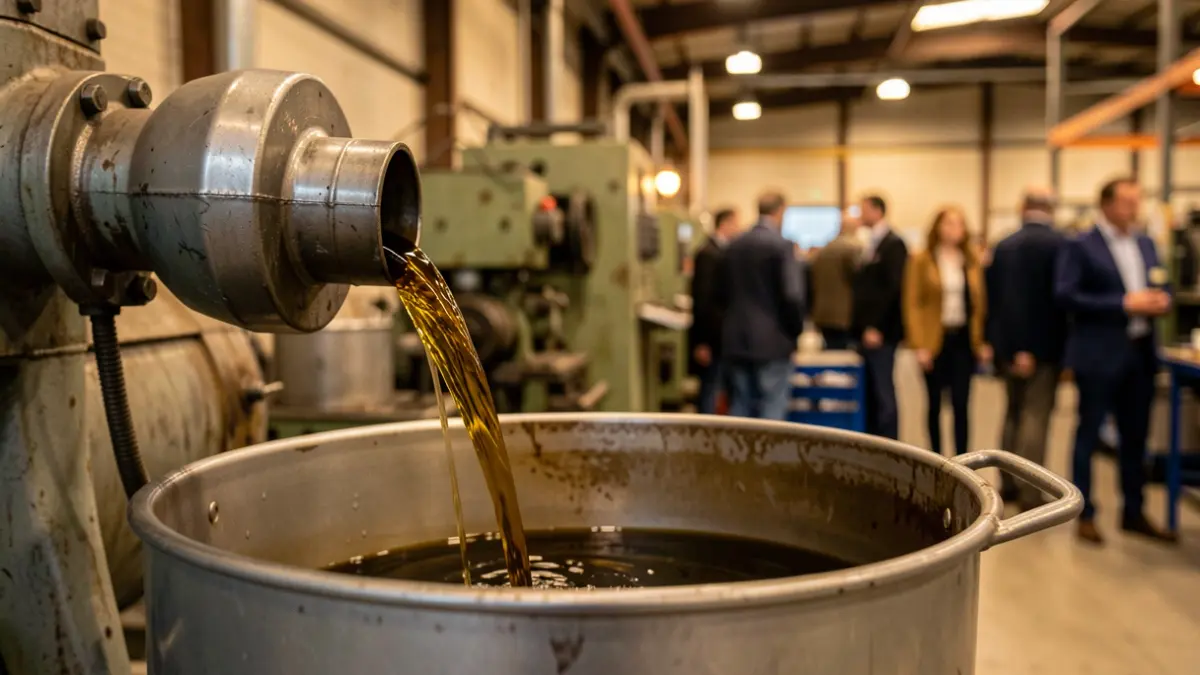
The organization Sigaus, responsible for managing industrial oil waste in Spain, reported that during 2025, all 13,516 tons of this residue from mechanical workshops and industrial facilities in the Community of Madrid were collected and fully recycled.
These materials were sourced from 6,292 establishments spread across 142 Madrid municipalities. Through this process, approximately six thousand tons of regenerated lubricants and three thousand tons of industrial fuel were produced. Manufacturing these same quantities through conventional methods would have required the equivalent of 3.1 million barrels of crude oil.
Industrial oil, essential for lubricating engines and machinery, degrades with use, accumulating toxic substances and heavy metals. Its high polluting capacity classifies it as hazardous waste; a single liter can contaminate up to one million liters of water.
After separating 6% water and sediment, 12,757 net tons of used oil were obtained. 73% of this volume, amounting to 9,337 tons, underwent regeneration, an environmentally favorable process. This allowed for the reintroduction of 5,845 tons of regenerated lubricants into the Madrid market, enough to fill the crankcase of 1.4 million passenger cars.
The remainder, 3,078 tons, was used to produce BIA fuel, a low-sulfur industrial combustible for furnaces and boilers. The recycling of this oil prevented the emission of 8,102 tons of carbon dioxide into the atmosphere, as the process requires less energy than producing lubricants from virgin oil.
Although mechanical workshops (60%) and industrial facilities (14%) are the main generators, Sigaus reminds that used oil also comes from sectors such as commerce, hospitality, transport, and agriculture.