The Spanish National Research Council (CSIC), through two research groups, is contributing key technological and experimental advancements to this consortium. The initiative integrates new technologies with experimental models and clinical validation to address neurodegenerative diseases.
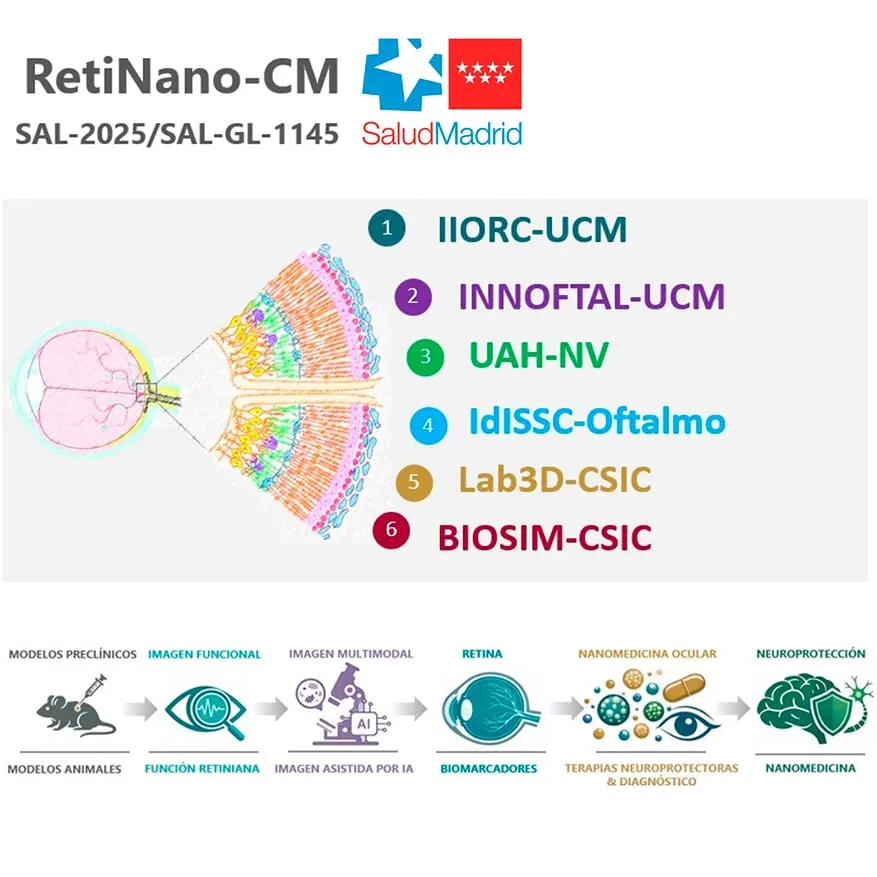
The project, which held its first working meeting on September 11 at the Ramón Castroviejo Institute for Ophthalmic Research, brings together six teams with complementary expertise in neurobiology, pharmacology, nanomedicine, neurophysiology, imaging, artificial intelligence, and clinical research.
From the Margarita Salas Center for Biological Research (CIB Margarita Salas), the Development, Differentiation, and Degeneration Laboratory (Lab 3D), led by Catalina Hernández Sánchez, will contribute its knowledge in retinal degeneration models. They will investigate the development and evaluation of nanoparticles with thermometric capabilities.
One of the research lines will explore nanothermometry, using nanoparticles capable of detecting local temperature variations potentially linked to inflammation and neurodegeneration. The goal is to determine if these signals can aid in the early diagnosis and monitoring of retinal diseases.
Meanwhile, the Biophotonics & Smart Imaging Lab (BIOSIM) at the “Daza de Valdés” Institute of Optics (CSIC), led by María Viñas Peña, forms one of the program’s main technological pillars. This group brings expertise in adaptive optics, biophotonics, multimodal retinal imaging, advanced image processing, and artificial intelligence.
These technologies will enable the acquisition of structural, functional, and metabolic information about the retina, the development of new quantitative optical biomarkers, and the analysis of large datasets using computational tools. The aim is to correlate this information with cellular, molecular, and functional changes, and subsequently with patient data.
RetiNano-CM is coordinated by the Ramón Castroviejo Institute for Ophthalmic Research at the Complutense University of Madrid. The project has received €1.1 million in funding from the Community of Madrid.