
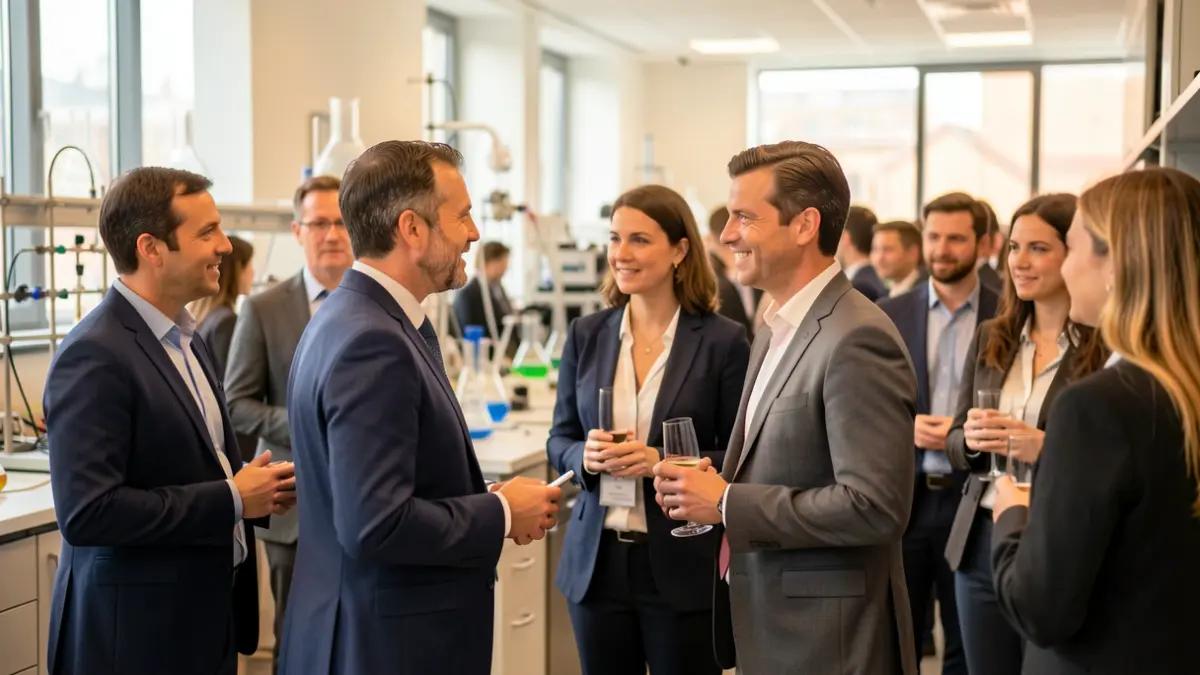
The event was organized as part of the Stanford LEAD Innovation Tour in Barcelona, held from October 7th to 9th. This annual initiative by the Stanford LEAD community aims to explore Barcelona and Catalunya's innovation ecosystems, connect with entrepreneurs and leaders, explore new synergies, and establish international contacts. IDAEA and IQAC hosted the itinerary focused on science and technologies applied to health, bringing together 29 international professionals from companies such as Google, Boeing, Salesforce, Stellantis, ING, SAP, and NetApp.
Following the institutional welcome by Olga López, director of IQAC-CSIC, and Alejandro Vázquez, Stanford LEAD representative, attendees learned about CSIC-developed technologies with transfer potential. Through brief presentations (pitches) and laboratory visits, advanced health solutions were presented, including rapid diagnosis of bacterial infections, photopharmaceuticals for glaucoma treatment, immune system therapies against cancer, behavioral analysis in aquatic models for new drug discovery, environmental technologies for monitoring water contaminants, and technologies for their removal.
The day continued with a session on co-creation in clinical trials led by RMIT University researchers Hannah Tribe and Gabriela Irrazábal. The event concluded with a panel discussion titled «Proof of System: How Barcelona Moves Healthcare Innovation From Pilot to Practice», moderated by Andreea Rasoga (NXP Semiconductors), with participation from Laura M. Lechuga (ICN2-CSIC), Joan Adan (InBrain Neuroelectronics), Eva Manrique (Barcelona Health Hub), and César Velasco (AstraZeneca).
The main conclusion from the panel was the necessity of a proof of system, in addition to a proof of concept, for health innovations. This involves demonstrating viability in a real hospital setting, adherence to budgets, and integration into clinical workflows, all while complying with strict European regulations. Speakers noted that obstacles are primarily related to implementation, scalability, and a lack of private venture capital in Europe, but concluded optimistically about Barcelona's position as a hub for artificial intelligence and digital health, highlighting its robust collaborative ecosystem.