Within the first test of the Mossos d'Esquadra selection process, alongside the knowledge sub-test, are the psychometric tests: 80 multiple-choice questions, each with four answer options, to be completed in 35 minutes. Doing the math, this leaves just over 25 seconds per question, a pace that in itself makes the sub-test one of the most tense moments of the entire process.In addition to speed, a cut-off score must be met: the sub-test is scored out of 10, and a minimum is required to pass and continue in the opposition. Neither blank nor incorrect answers deduct points, so one of the first recommendations from specialists is simple: do not leave any answer unmarked, even if it's a random guess in the final seconds.
Beyond the stopwatch, the real difficulty of the test is that it mixes various types of reasoning, each with its own logic and training.
Verbal reasoning
Assesses the ability to work with the meaning and relationships between words: synonyms, antonyms, analogies, or identifying the odd one out in a series of concepts. It doesn't require an extensive vocabulary, but rather speed in detecting the relationship that unites -or breaks- the words presented.
Example: indicate which word is unrelated to the others: book, magazine, armchair, newspaper.
Numerical reasoning
Tests agility with numerical series, simple percentages, and basic operations. The key is not to perform complex calculations, but to quickly identify the pattern the series follows.
Example: complete the series: 3 – 7 – 15 – 31 – ?
Abstract reasoning
For many applicants, this is the strangest type at first: instead of words or numbers, it involves geometric figures. They are often presented as matrices of figures - frequently in three-by-three grids - where each cell varies in shape, shading, or number of elements following a pattern by rows and columns, and you have to guess which figure, from several options, correctly completes the sequence.
Spatial reasoning
Measures the ability to visualize objects in three dimensions and imagine their rotations or folds. A common exercise is the net of a cube: the six faces are shown unfolded on a sheet, and you have to identify, from several options, which three-dimensional cube would be formed by folding it.
Practice each type separately, and then against the clock.
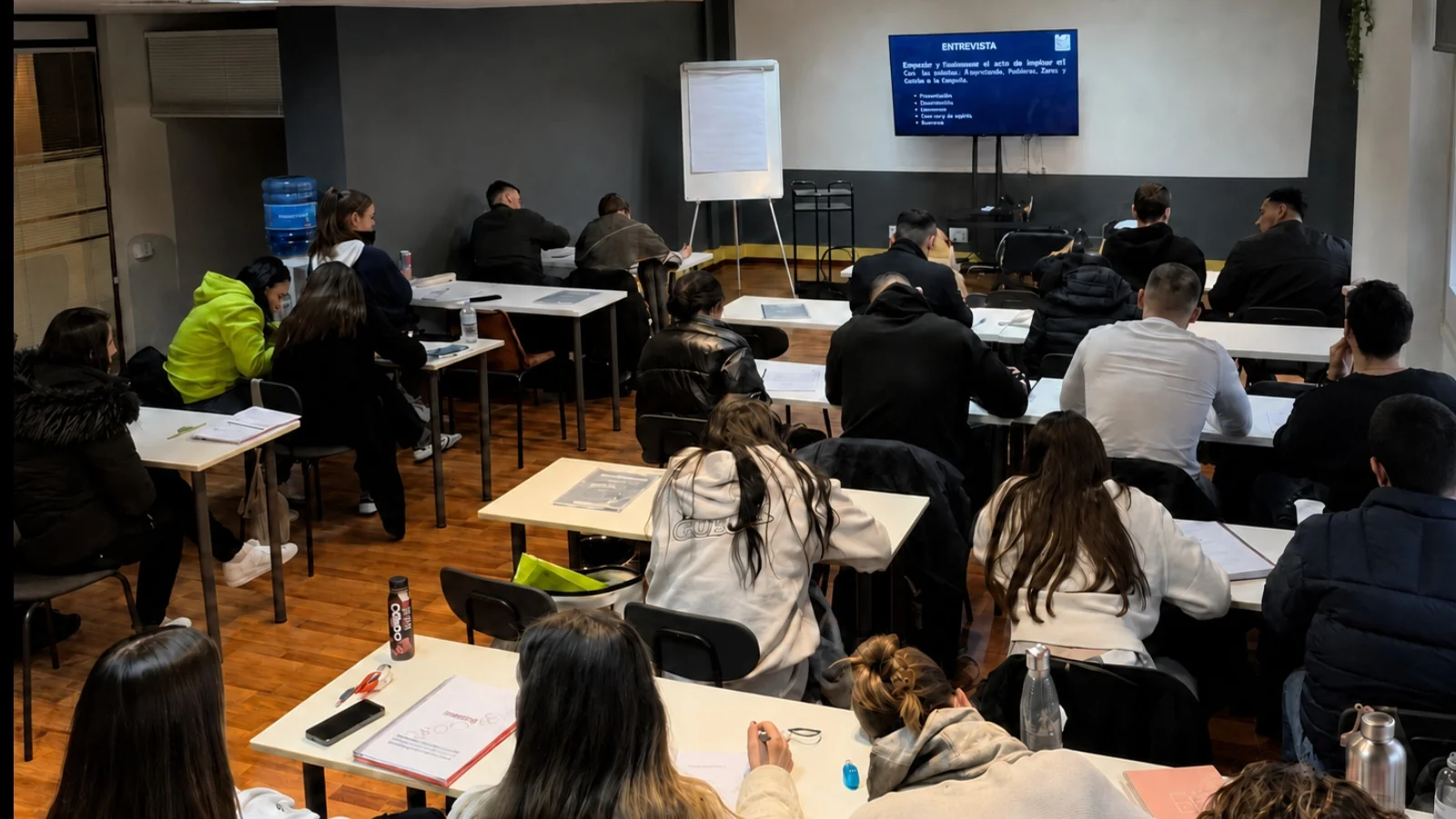
At OPOCME, an academy specializing in preparing for this opposition, they emphasize that psychometric tests are, above all, a matter of training: in classes, each type of exercise is worked on separately - verbal, numerical, abstract, and spatial - with specific tricks and methods to solve them faster, before moving on to the test phase and exam simulations under real time conditions.
The goal of this working method is that, on the day of the exam, the applicant doesn't have to figure out how to solve each question from scratch, but rather immediately recognizes the type of exercise and applies the already trained method, saving precious seconds in a test where time is precisely the most critical factor.