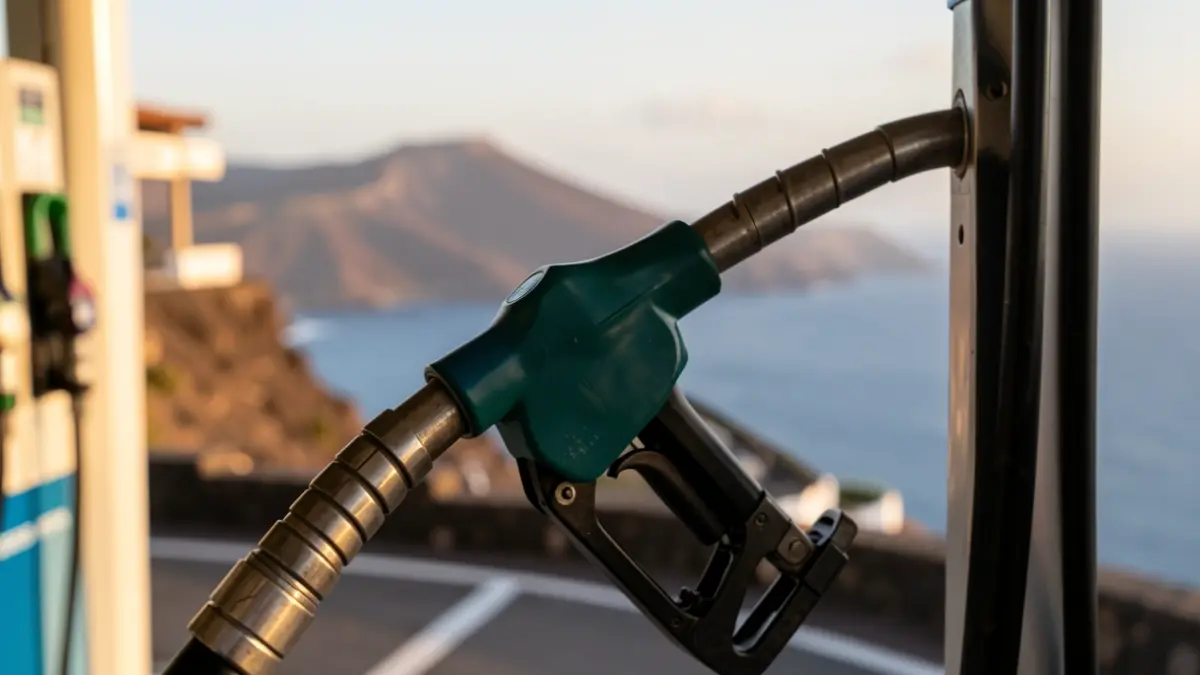
The conflict in the Middle East has triggered a notable surge in fuel prices, significantly affecting consumers in the Canary Islands. Currently, refueling a vehicle on the islands represents a considerable expense, with prices at their annual peak and approaching historical highs.
Diesel A reached its annual maximum on September 22nd, standing at 1.674 euros per liter, according to data from the National Markets and Competition Commission (CNMC). While the CNMC provides regional data without island differentiation, the National Institute of Statistics (INE) does offer weekly island-specific figures. The latest data, for the week of September 7th to 13th, shows that La Gomera recorded an average price of 1.842 euros per liter, followed by El Hierro at 1.831 euros, and La Palma at 1.780 euros, marking these islands as having the most expensive fuels.
The situation for 95 octane gasoline drivers is no different. On September 22nd, this fuel reached 1.533 euros per liter in the Canary Islands, according to CNMC data. Although this figure is not the absolute historical peak—which occurred between June 27th and July 3rd, 2022 (1.632 euros per liter) during the energy crisis stemming from the war in Ukraine—current prices in islands like La Gomera (1.684 euros), El Hierro (1.664 euros), and La Palma (1.657 euros) indicate a strong upward trend.
Renewable diesel is also nearing its annual high, touching 1.781 euros per liter, a figure matching the maximum recorded in April. These figures underscore the pressure fuel prices are placing on the economy of Canarians, further contributing to the rise in general inflation due to the archipelago's reliance on transportation. In August, the CPI showed an increase of nearly 20% in fuel prices compared to the previous year.
Geopolitical tensions in the Middle East, with the price of Brent crude hovering around 100 euros this week following new attacks and intermittent blockades of the Strait of Hormuz, coupled with the conflict in Yemen and its impact on Saudi oil exports, do not suggest a cooling of the situation in the near future.