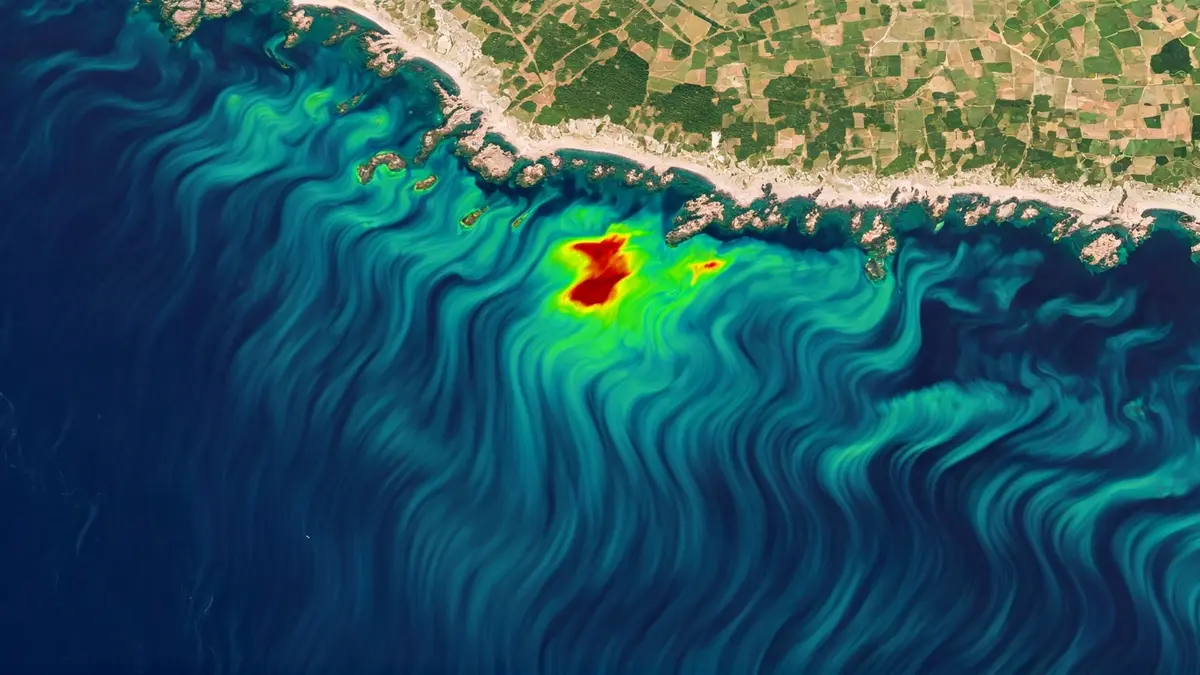
This work, led by the UCA, represents a significant milestone in monitoring bathing water quality. For the first time, the feasibility of detecting contamination associated with Escherichia coli and Enterococcus, key indicators of fecal contamination, from space using Sentinel-2 satellite images has been demonstrated.
The research team included Masuma Chowdhury, Irene Laiz, and Ignacio de la Calle. Irene Laiz, from the Department of Applied Physics and the University Institute for Marine Research (INMAR) at the University of Cádiz, supervised Masuma Chowdhury's industrial doctorate, who is also affiliated with the UCA and the company Quasar Science Resources S.L.
The study initially focused on 20 tourist beaches in Calvià, Mallorca, developing empirical models capable of differentiating fecal contamination from other water quality parameters. These models showed strong predictive capabilities, allowing for the mapping of contamination episodes and the identification of their sources.
This approach constitutes a paradigm shift for monitoring fecal bacteria in coastal recreational waters, offering a much broader spatial scale than conventional sampling methods.
A practical example of its utility was observed at Cala Vinyes beach in 2024, where satellite maps indicated high concentrations of fecal contamination. The municipal company Calvià 2000, upon being alerted, was able to identify the source of the discharge in a nearby hotel's septic tank, precisely in the area highlighted by the maps.
This scientific advancement directly connects with environmental observation strategies being implemented in the Bay of Cádiz. Since 2025, beaches in the bay have been equipped with a network of smart buoys that measure real-time physicochemical and microbiological parameters, including E. coli and enterococci. Satellite observation complements these systems, providing a crucial spatial dimension to delineate the extent of discharges and guide decision-making.
Although the models require further refinement through new sampling campaigns, the results lay the groundwork for future near real-time operational alert systems, strengthening coastal environmental management, public health protection, and bathing water safety. The study also highlights the importance of public-private collaboration, such as that with Calvià 2000, for scientific progress.