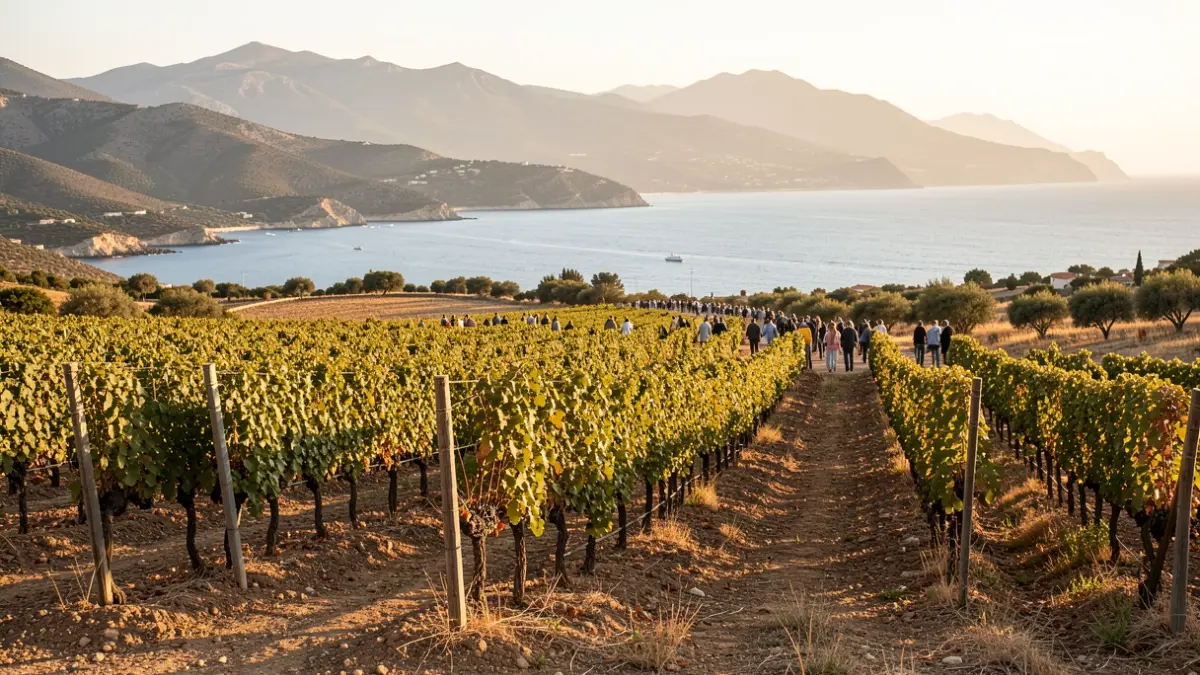
The history of this company can be told as that of a family and also as that of a landscape: that of vineyards open to the Mediterranean, protected by mountains, and worked for generations, marked by the recognizable aroma of Alexandria Moscatel when it ripens at the end of summer in La Marina Alta. The trajectory began in the second half of the 19th century, encompassing carts, inns, wholesale markets, warehouses, new estates, own wines, and a vision for agricultural future.
The origin dates back to Vicente Cabrera Baydal, a transporter of the time, who managed to gather money to buy a farm in the Quisi area, which later became Casa de Cristina, linked to the production of raisins and almonds. He sold these products at the port of Dénia, from where they departed for England, with raisins being a key economic driver for the region.
That first step of acquiring land opened a path that today reaches the fifth generation. Vicente's fifth son, Joaquín Cabrera Ausina, made a decisive turn by taking over the Hostal de Benissa. There he met numerous Moscatel buyers, including José Sanchís from Picassent, who convinced him to dedicate himself more seriously to the buying and selling of this grape variety.
Joaquín Cabrera left the inn to focus on grapes, combining the role of a broker with production. The Dénia market became a key point, with the help of his children, Vicente and Teresa Cabrera Sala, who became involved in the family business from a young age.
The commercial leap occurred in the fifties with the purchase of the first van, allowing fresh Moscatel to be transported to Valencia. Faced with the decline of the Valencian wholesale market, the family opened an agricultural products store in Benidorm, where Vicente and Teresa mainly sold Moscatel. Later, Vicente returned to the business with a more ambitious vision, taking the grape to markets such as Barcelona, Madrid, Murcia, Orihuela, and Novelda.
As a result of this growth, in 1973 the current warehouse was built on Lluís Vives street in Benissa, an important step towards professionalization. Investment in new lands, including Hondón de las Nieves in the Medio Vinalopó region, known as the 'valley of grapes', expanded capacity.
The fourth generation, Ximo and María Francisca Cabrera, began helping in the nineties, establishing Agrícolas Hnos. Cabrera S.L. The purchase of a second warehouse in Novelda allowed for better processing of produce from the Vinalopó region. Today, the fifth generation, led by Dani Cabrera and his cousin Izan, reinforces the continuity of the family line.
Currently, Uvas Cabrera has estates in Benissa, Gata de Gorgos, Dénia, and Teulada, and is incorporating land in Hondón de las Nieves to extend the season. The company faces challenges such as climate change and droughts, promoting the installation of drip irrigation and the transformation from traditional bush cultivation to trellising for better management and more ecological farming.
The trajectory of Uvas Cabrera is a story of constant adaptation. Now, the company is working on national and international expansion, aware of the unique identity of La Marina Alta's Moscatel. This balance between memory and future explains its incorporation this year into the Club of Centenary Companies of Alicante province, along with seven other firms recognized by AEFA and the Chamber of Commerce, who will be honored on June 3rd.
Alexandria Moscatel, appreciated as a table grape, for raisins, and winemaking, has a musky flavor and great aromatic intensity. Uvas Cabrera's estates, near the sea and nestled among mountains, give the grape an intense flavor with unique nuances and salty touches. The company markets the grapes in two and five-kilogram boxes and, since 2016, has opened new business lines with Moscatel derivatives, such as its first wine, 'Ximo Cabrera'.