
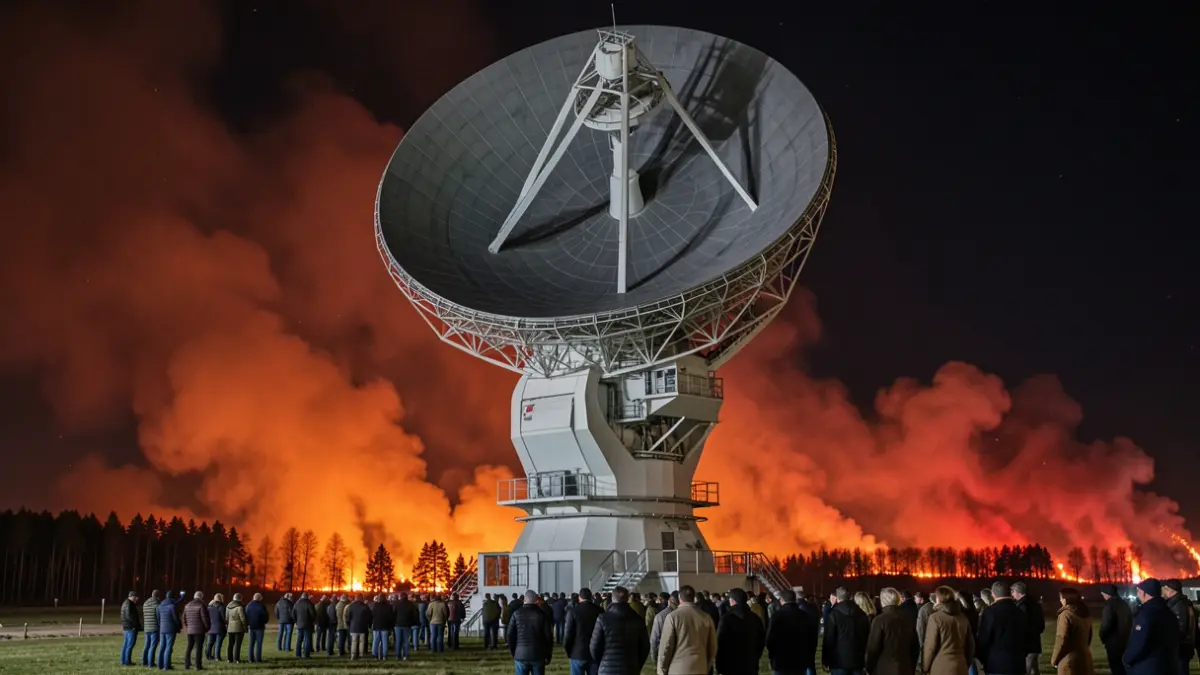
NASA's deep space communication complex, located on the outskirts of Robledo de Chavela, is in a "critical situation" due to an advancing wildfire that has already forced the evacuation of over 60,000 people in the area. According to initial reports, all center personnel have been evacuated as flames approach the facilities. While government sources confirm no major damage has been reported, there is significant concern about the potential compromise of one of the world's three nodes responsible for tracking interplanetary space missions, including the robots exploring Mars and the antenna that captured the signal from the Apollo 11 moon landing.
NASA's Global Tracking Network, for which the Madrid center is an essential node, is under threat. Local authorities and the U.S. Embassy, the official owner of the center along with the National Institute of Aerospace Technology (INTA) and the Ministry of Defense, are working collaboratively to assess the impact. U.S. administration sources have confirmed the fire has entered the compound and stated that any damage will be evaluated when it is safe to do so. Meanwhile, scientific tasks have been transferred to facilities in California to ensure service continuity.
The Deep Space Communications Complex in Madrid (MDSCC), operational for over 60 years, is one of NASA's three key global nodes, alongside those in Goldstone (California) and Canberra (Australia). These facilities are crucial for the 24/7 monitoring of satellites, space telescopes, and Mars rovers. It was from this very location that the success of the Apollo 11 moon landing was first captured on July 16, 1969. Currently, the center monitors missions such as the Artemis program to the Moon and the James Webb Space Telescope.
According to previous statements by center officials to El Periódico, the Madrid antennas have tracked over 40 space missions monthly. The complex features six antennas, including one with a 70-meter diameter. Hope lies in the sheer size of these structures, which may have withstood the most devastating effects of the flames.