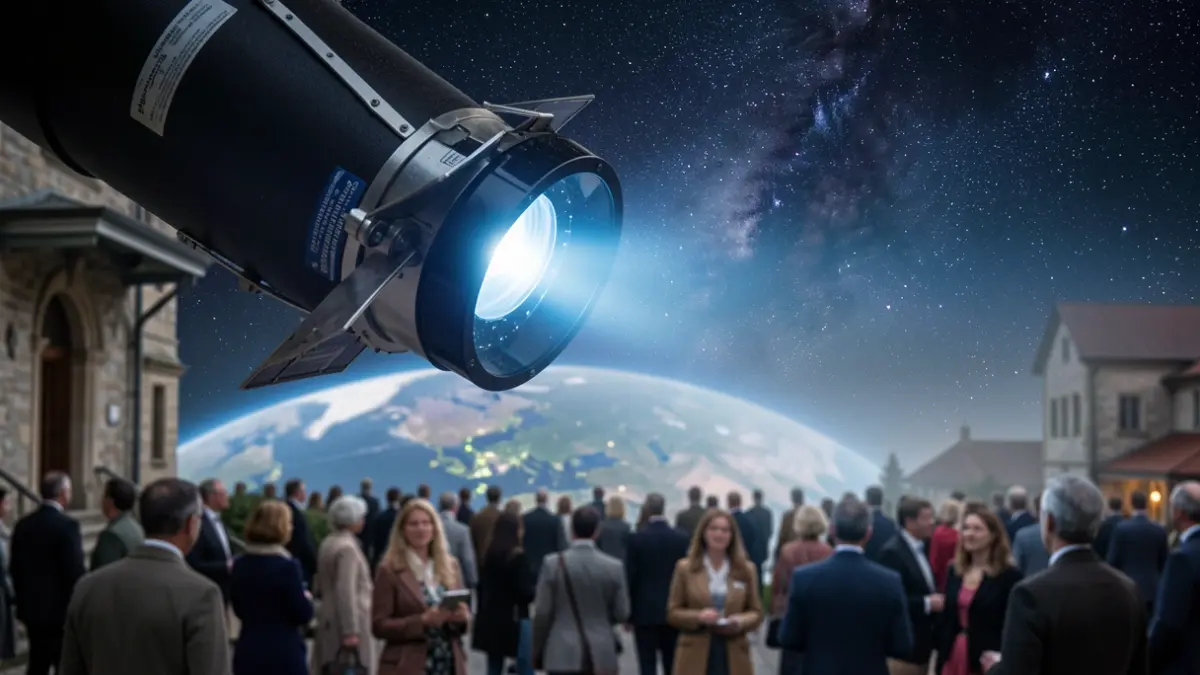
The European Space Agency's (ESA) FLEX (FLuorescence EXplorer) satellite has been launched into space, marking a milestone in Earth observation. This mission, the culmination of over two decades of development, features significant participation from the University of Valencia, through its Earth Observation Laboratory (LEO) and Image Processing Laboratory (LPI), located at the Parc Científic de la Universitat de València (PCUV). The launch took place from the European spaceport in Kourou, French Guiana, alongside the Sentinel-3C satellite, aboard a Vega-C rocket.
FLEX ushers in a new era of Earth observation, providing unprecedented global measurements of vegetation functioning. Over the next four years, the satellite will allow for detailed analysis of how plants respond to climate change phenomena such as drought, heatwaves, and environmental stress. The mission focuses on measuring solar-induced fluorescence, a faint light signal emitted by chlorophyll during photosynthesis, offering direct insight into the vegetation's internal processes.
José Moreno, Professor of Earth Physics at the University of Valencia and the mission's principal investigator, has been a pivotal figure in FLEX's development. Under his leadership, the LEO group has substantially contributed to transforming an ambitious scientific concept into a European mission aimed at better understanding planetary-scale photosynthetic activity in vegetation. Moreno emphasizes that FLEX will enable the quantification of photosynthetic activity, carbon assimilation, and vegetation's adaptation capacity to environmental stress, representing a qualitative leap in Earth Observation capabilities.
With a spatial resolution of approximately 300x300 meters, FLEX will be the first satellite mission dedicated to globally measuring the full spectrum of vegetation fluorescence emission. This capability will allow for the detection of changes in photosynthetic activity before they become visible in plant color or structure, a crucial tool for addressing drought or environmental stress episodes. The mission will operate in tandem with the Sentinel-3 satellite, which will provide complementary information on vegetation, the atmosphere, and the Earth's surface.
FLEX is the eighth mission in ESA's Earth Explorer program, designed to investigate key Earth system processes. The data obtained will contribute to climate change studies and the management of agriculture, forests, and terrestrial ecosystems. The LEO group at the University of Valencia has played a fundamental role in the mission's scientific conception and development, including the creation of simulators like FLEX-E and research lines funded by the European Research Council.
The LEO group also participates in field campaigns for the calibration and validation of FLEX products, comparing space-based data with ground measurements to ensure the scientific quality of the mission's information. The mission will enhance the monitoring of plant productivity, early detection of water and thermal stress, study of the carbon cycle, and assessment of crop and forest ecosystem health, reinforcing the IPL's position as an international benchmark in Earth observation from the UV Science Park.