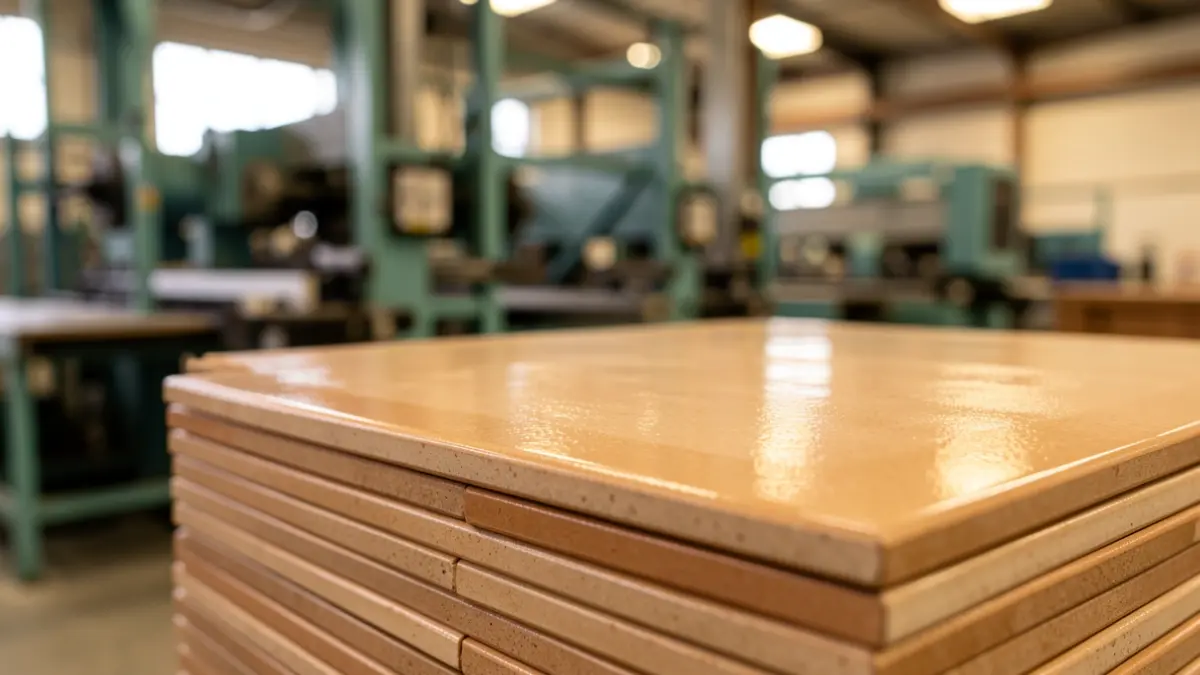
The EU's proposal includes a 34% cut in free emission allowances for ceramics, a move that could result in an annual economic impact of up to 160 million euros for the Spanish tile sector and an additional 50 million for glazes.
Business organizations and companies from both Spain and Italy, the main European producers, along with other traditional manufacturing sectors such as coal, aluminum, copper, cement, foundry, glass, chemical, and paper, have filed appeals in response to the public consultation launched by Brussels. The primary demand is the establishment of a specific reference value for ceramics that considers its technological reality and curbs the proposed cost increase by the European Commission.
The Italian Government has already presented its own proposal, while Spain, France, Germany, and Estonia are working together within the Council of the European Union to achieve the immediate implementation of this sectoral 'benchmark'.
From the Spanish ceramics industry, mainly concentrated in Castellón, around thirty appeals have been submitted. Entities such as Ascer, Anffecc, the Provincial Council of Castellón, the city councils of Onda and la Vall d'Uixó, along with about twenty companies in the sector, have conveyed their concerns to Brussels.
From Italy, the Ministry of Environment and Energy Security, the Confindustria employers' association, and the Emilia-Romagna region support the initiative. Appeals have also been received from various industrial sectors in other European countries such as Germany, France, Austria, Denmark, Sweden, Hungary, Poland, Slovakia, Czechia, the Netherlands, Bulgaria, Belgium, and Portugal.
"The system risks shifting from an instrument to incentivize emission reduction to a factor increasing costs and loss of competitiveness, without commensurate environmental benefits," warns Confindustria. The Italian employers' association urges the European Commission to temporarily freeze the reference values for free allocation at 2025 levels, arguing that sectors with hard-to-abate emissions still lack mature and competitive alternatives.
The European ceramics industry, through Cerame-Unie, expresses its concern and believes that, until the system's benchmarking methodology is adapted to the technological reality, the EU "should suspend any further reduction of the RCDE reference parameters," which are already, on average, 22.4% lower for European ceramics compared to the reference values from the 2013-2020 period.
From Spain, Ascer leads the proposals and requests the European Commission to develop specific sectoral 'benchmarks' for sectors lacking viable decarbonization alternatives. It considers it necessary for the regulation to establish a clear legal framework, ensuring legal certainty and an application of the ETS consistent with the principles of technological viability and economic efficiency.
The outcry from European industries is widespread. They advocate for decarbonization but reject economic penalties that, in their view, could lead to business closures, relocations, and reduced investment capacity in green projects.
The European Commission has opened the door to creating specific 'benchmarks' in a review of the Emissions Trading System (ETS) planned for July. Meanwhile, the governments of Spain, France, Germany, and Estonia are pressuring the Council to secure a specific reference value before the ETS modification.