
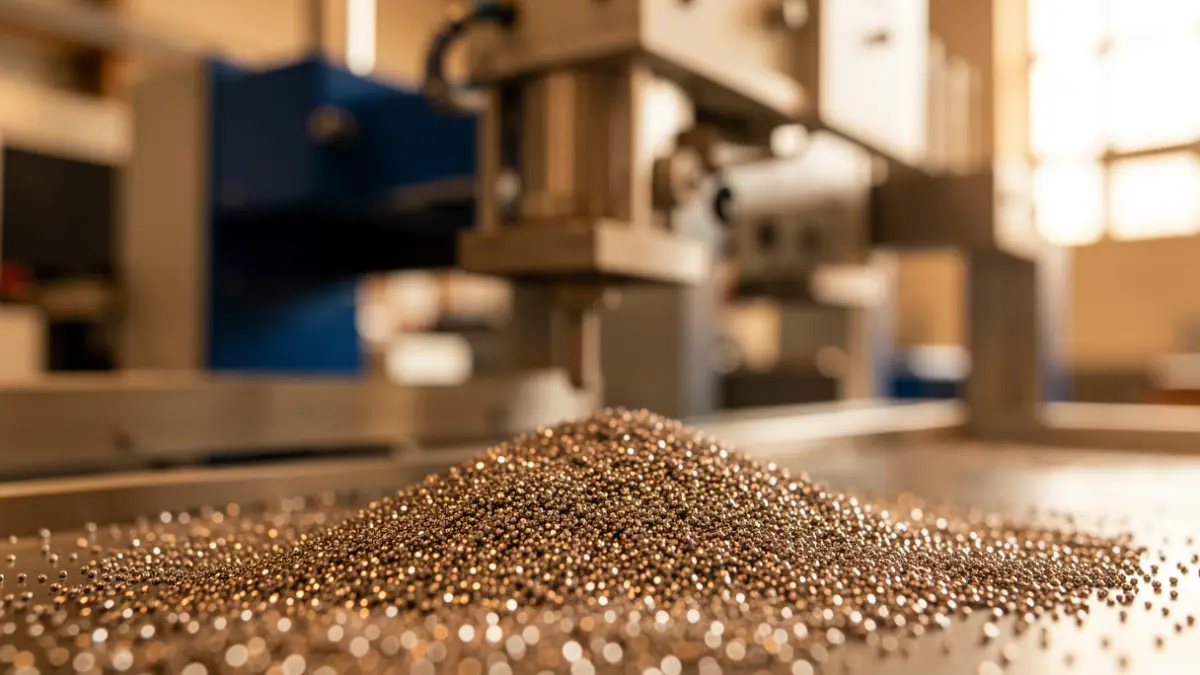
Additive manufacturing is revolutionizing the production of metal components in key sectors such as aeronautics, automotive, and energy. One of the most promising technologies is binder jetting, which enables the creation of metal parts quickly, precisely, and at scale.
A crucial challenge for the sustainability of this process is the reuse of metal powders. After each print, these powders undergo handling and transportation that can alter their properties and lead to losses, affecting the quality of the final parts.
To address this challenge, Andrea Alonso Romero, a predoctoral researcher at the IMDEA Materials Institute, focuses her work on the reuse of metal powders and the sintering process, a fundamental stage for imparting definitive mechanical properties to the parts.
Thanks to a Fulbright scholarship, Alonso Romero will undertake an eight-month stay at the Illinois Institute of Technology (IIT) in Chicago. There, she will analyze how powder reuse affects the sintering process and component performance, in collaboration with HP and the technology center AMES.
Her research combines the study of metal powder degradation with the analysis of material consolidation processes. "The goal is to connect the two main parts of my doctoral thesis and understand how powder reuse affects the sintering process and, consequently, the final quality of the parts," explains Alonso Romero.
Currently, many companies mix reused powder with new material to maintain quality. However, increasing the proportion of reused powder could significantly reduce raw material consumption and production costs. "Excessive reuse can lead to defects in the final parts. That's why we want to understand exactly what happens to these powders during the process and how we can increase the percentage of recycled material without compromising quality," notes Alonso Romero.
During her stay at IIT, she will have access to advanced equipment to analyze powder flowability and better understand their degradation. Additionally, the team will conduct experiments at the Advanced Photon Source (APS), a cutting-edge synchrotron, to observe in real-time how materials evolve during sintering using in situ tomography.
"It's a huge opportunity. It's not just a scholarship, but a way to connect with researchers worldwide who share similar goals and establish collaborations that can continue throughout one's research career," states Alonso Romero.
Alonso Romero, who holds a degree in Industrial Engineering from the Universidad Carlos III de Madrid and a Master's in Materials Science and Engineering, completed her undergraduate and master's thesis work at IMDEA Materials. Her doctoral thesis is supervised by Dr. Alberto Meza and Dr. Federico Sket.