Approximately 1.05 billion tonnes of food are wasted globally each year, accounting for about 19% of food available to consumers, according to the United Nations. When considering losses from production, storage, transport, and processing stages, it is estimated that about one-third of all food produced for human consumption worldwide never reaches our plates.
This problem is compounded by environmental pressure, as the agri-food system is responsible for approximately one-third of global greenhouse gas emissions and is a major driver of biodiversity loss and land-use change. Concurrently, population growth and evolving consumption patterns are increasing global protein demand.
This is the context for REPAG, an R&D project led by the startup ODS Protein, where CETIM Technological Centre coordinated the research to achieve a biotechnological process that transforms agri-industrial by-products into a high-value-added ingredient for human consumption: microproteins.
Why microproteins?
The search for new, more efficient, sustainable protein sources with improved properties has become a strategic priority. Microproteins are emerging as one of the most promising alternatives due to their high nutritional value, their production capacity through fermentation, and their potential to utilize agri-food by-products as raw material.
Microproteins are vegan proteins derived from filamentous fungi, cultivated through fermentation. This technology requires less space and water consumption than animal production and can reuse residual organic substrates. Consequently, in recent years, these ingredients have emerged as a sustainable alternative for human food, animal feed, and even cosmetics.
The REPAG project has gone a step further, creating a new value chain based on the circular economy and the valorization of agri-industrial by-products. Potato waste, discarded during the industrial production of potato chips by Patatas Fritas Guays, has been transformed into high-value-added ingredients for human consumption through biotechnological fungal fermentation processes in liquid media developed at CETIM. This process was subsequently scaled up by ODS Protein. Below, we explain the process in detail.
The use of biotechnology in the valorization of agri-food waste
REPAG is based on the principles of the circular bioeconomy, applying biotechnological processes capable of converting low-value waste streams into functional ingredients with high commercial potential. The developed technological strategy includes the following successive stages:
• Physicochemical identification and characterization of by-products from potato production and processing.
• Evaluation of their nutritional composition and potential as fermentable raw material.
• Development of treatments to condition these by-products into suitable culture media for microorganisms of biotechnological interest.
• Design and optimization of fermentation processes based on filamentous fungi capable of generating protein-rich biomass.
• Scaling and validation of bioprocesses at pilot level and nutritional and functional characterization of the obtained microproteins.
The ultimate goal is to demonstrate the technical, economic, and environmental viability of a new food value chain capable of reducing agro-industrial waste while simultaneously producing high-quality alternative proteins.
CETIM: REPAG's scientific engine
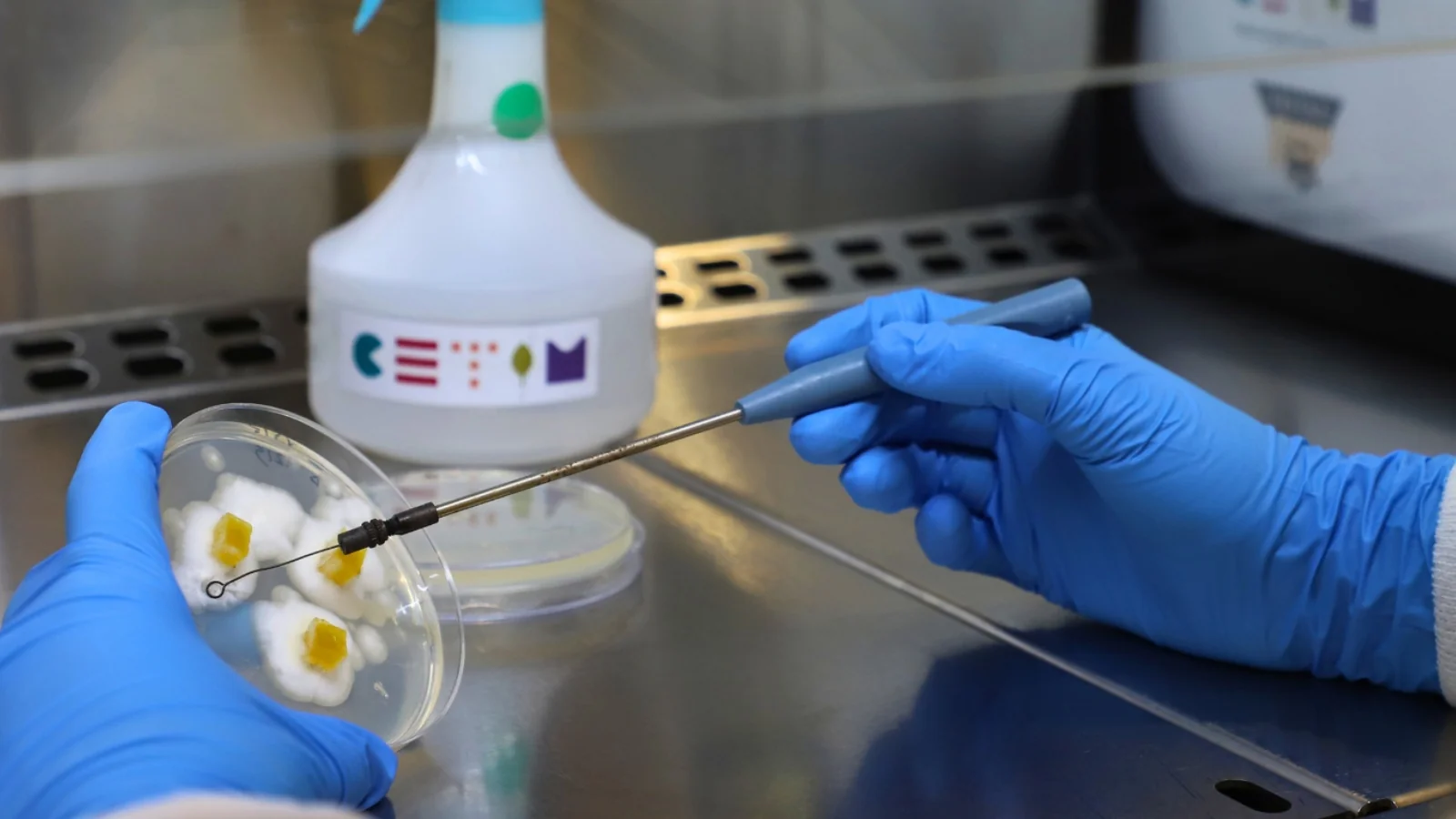
As part of the consortium, CETIM Technological Centre was responsible for the scientific developments related to the biotechnological valorization of potato by-products. The Technological Centre participated in all phases of the process, starting with substrate preparation, where potato by-products are ground and subjected to a controlled acid treatment to release glucose and other sugars. This increases nutrient bioavailability for the fungi used in the next stage: fermentation.
Selected strains of filamentous fungi are inoculated into the culture medium prepared from the treated material. These fungi metabolize the available nutrients and produce protein-rich fungal biomass under controlled conditions. Once the desired biomass quantity is reached, it is separated from the culture medium through a conventional filtration process and washed to remove unwanted by-products.
Subsequently, the obtained biomass is analyzed to determine its composition and nutritional quality, including parameters such as protein, carbohydrate, fiber, and moisture content, as well as other compounds of interest for human consumption. Variables associated with the production process, such as growth conditions, conversion yield, productivity, and final product quality, are also evaluated. This information enabled the successful pilot-scale scale-up of the microprotein production process, in which CETIM collaborated with ODS Protein.
From by-product to key ingredient
REPAG has demonstrated the technical feasibility of transforming potato processing by-products into microproteins, with promising results in yield and nutritional quality. Biotechnological assays conducted by CETIM Technological Centre show that potato by-products are suitable substrates for fermentation without complex pre-treatments, highlighting their potential for producing new, high-nutritional-value foods on an industrial scale.
“"Compared to conventional methods, at CETIM, through REPAG, we have managed to triple protein levels in one of the studied fungal species. We obtained nearly 40 grams of protein per 100 grams of treated by-product, demonstrating the production potential from industrial waste"
The results also indicate that the nutritional value of fungi cultivated in culture media made from potato by-products significantly improves compared to those obtained using conventional fermentation media. In addition to proteins, the resulting biomass contains valuable nutrients, such as omega-6 and omega-9 unsaturated fatty acids, and has low sodium content, reinforcing its potential for developing healthy food products. Furthermore, mycotoxin analyses confirm that the product complies with food safety criteria, with all values found below detection limits.
The sustainable and circular future of food
REPAG opens the door to a local, low-environmental-impact production model based on the valorization of agri-industrial by-products. This approach not only contributes to waste reduction but also diversifies the food system, decreasing reliance on animal protein and moving towards a more circular, resilient model aligned with the principles of the bioeconomy and European strategies for sustainability and a just food transition.
Moreover, REPAG positions CETIM as a leading scientific player in biotechnology applied to the agri-food industry, reinforcing its expertise in waste valorization through advanced biological technologies. The Technological Centre is currently involved in other research in this field, such as the Cervera Excellence Network OMIPERBIO, which will produce microbial proteins, phenolic compounds, and other bio-ingredients from various by-products using omics technologies.
Additionally, in recent years, the research organization has strengthened its infrastructure dedicated to the circular economy through Circular Excellence, an initiative funded by the Galician Innovation Agency and co-financed by the European Union through the FEDER Galicia 2021-2027 program, to promote production models based on material reuse, waste reduction, and resource optimization.
The REPAG project was awarded by the Galician Food Quality Agency under the call for Operational Groups 2023 of the European Innovation Partnership (EIP) (MR331B) and is co-financed by the European Agricultural Fund for Rural Development (EAFRD) within the Strategic Plan for the Common Agricultural Policy (SPCAP) 2023-2027. Rural Development Programme of Galicia 2014-2020. Measure 16.