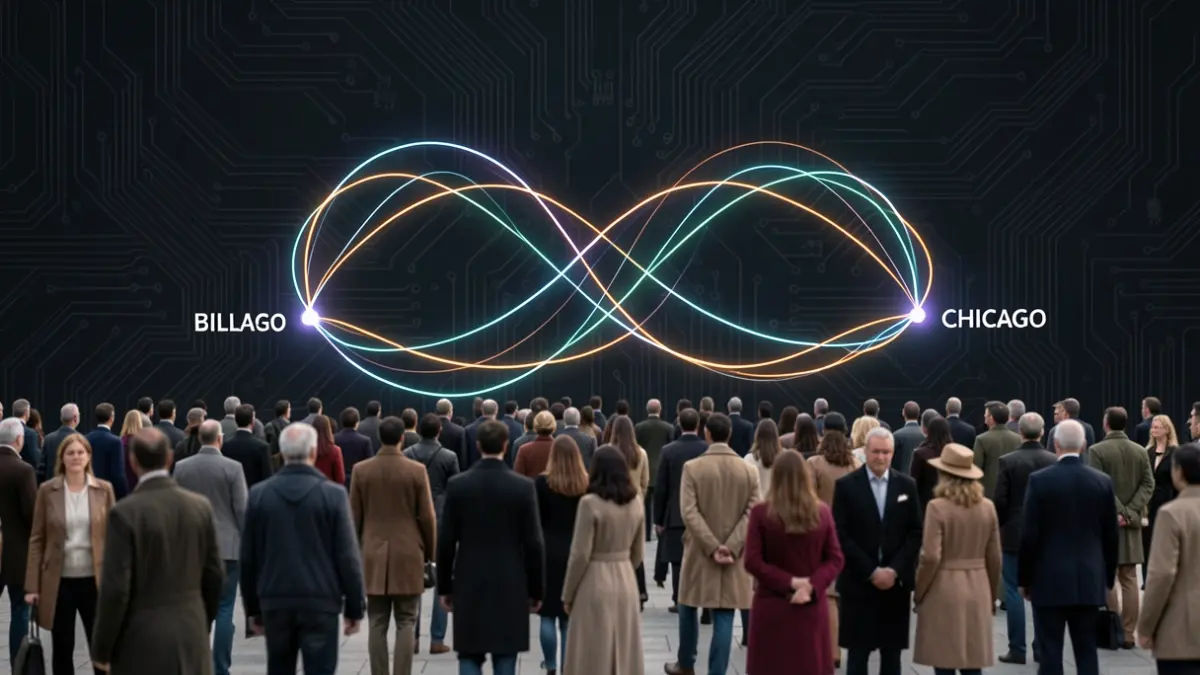
The University of the Basque Country (EHU) has presented a technology in Chicago to protect communication confidentiality against future quantum computers. The demonstration took place at SC26 (Supercomputing 2026), connecting the Bilbao School of Engineering with a stand at the fair.
A significant portion of internet security relies on cryptographic methods that could be vulnerable to future quantum computers. To address this, the EHU's I2T research group has developed QuLore, a technology that combines two approaches: quantum key distribution (QKD), which uses quantum phenomena to securely transmit keys, and post-quantum cryptography (PQC), based on new mathematical algorithms resistant to quantum attacks.
“"QuLore combines the two major families of quantum-safe solutions currently available. The first is quantum key distribution (QKD), which transmits keys by relying on quantum phenomena, ensuring that any attempt to intercept them alters the mechanism and exposes the attack. The second is post-quantum cryptography (PQC), based on new mathematical algorithms, recently standardized, designed to withstand attacks from quantum computers and already operational on current networks."
The initiative involves collaboration with academic and research networks such as I2Basque, RedIRIS, SURF, and Pioneer/PCCS, as well as the pan-European network GÉANT. Companies Ciena and LuxQuanta also participate.
The link between Bilbao and Chicago has combined both technologies: approximately 25 km of dedicated fiber optic with QKD between the Bilbao School of Engineering and the CFAA in Zamudio, and keys agreed via PQC over conventional internet connections from the CFAA to Amsterdam and Chicago. At the fair itself, QKD was used between Ciena and PSNC stands (800 meters apart) for data encrypted at 1.6 terabits per second.
Eduardo Jacob clarifies that "to ensure everything works simply and adaptively, the QuLore software orchestrates two cryptographic key management systems: eduKMS, developed by SURF, and vKMS, developed by EHU. This will securely establish the keys that protect end-to-end communication and prevent third parties from accessing the exchanged information."
Security is tested at three levels: optical networks, inter-network connections, and user applications. In the latter case, the team has adapted an open-source video conferencing application to encrypt audio and video conversations with keys resistant to the quantum threat.
Through this demonstration, EHU aims to prove that it is possible to protect communications against quantum attacks by adaptively integrating different technologies over real networks and with commercial equipment from various manufacturers.