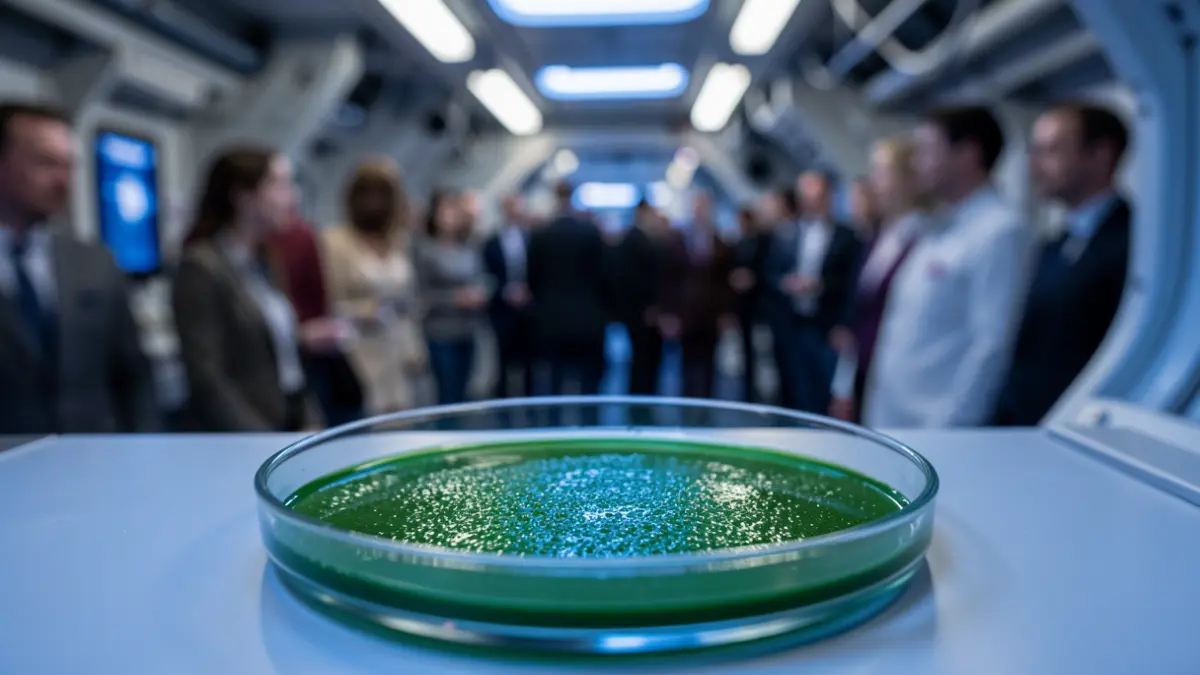
Spirulina, a cyanobacterium scientifically known as Limnospira indica, will travel for the first time to the International Space Station (ISS). The objective is to conduct an experiment to determine if this microorganism can be cultivated in microgravity conditions. This algae has the ability to capture carbon dioxide, produce oxygen, and serve as a food source, characteristics that make it particularly valuable for life in space.
The experiment is part of a project developed at the Melissa pilot plant of the UAB, with the collaboration of the company Sener and the Institute of Microelectronics of Barcelona. Funding comes from the Spanish Space Agency through the European Space Agency. It is anticipated that a Spanish astronaut, possibly Pablo Álvarez Fernández, will be responsible for carrying out the cultivation during their first mission to the station, scheduled for early next year.
The director of the Melissa pilot plant, Francesc Gòdia, highlights the importance of bioregenerative systems for long-duration missions, which allow for the transformation of crew waste into useful resources such as water, oxygen, or food. Currently, food is transported from Earth and waste is eliminated from the station, limiting crew autonomy.
The technical coordinator of Melissa, Carol Arnau, points out that the experiment aims to verify if astronauts can live in space for extended periods without relying on supplies from Earth, thereby reducing dependence on Earth. These closed-loop systems, which have already proven effective on Earth, have been under investigation for thirty years.
The cyanobacterium will travel in a miniaturized unit with cultivation cassettes, equipped with inlet and outlet ports, photonic sensors, LED lighting, and electronic systems for monitoring. Samples will be kept in sterile bags and in darkness until they reach the ISS, where an astronaut will place them in an incubator at 36 ºC to grow in microgravity.
The quality director at Sener, Eva Creus, explains that one of the main challenges has been the miniaturization of the equipment to adapt it to the astronaut's needs. For 15 days, the evolution of the samples will be studied, and the results will be compared with those obtained at the Melissa pilot plant. If spirulina proves suitable for space cultivation, it will become an ideal candidate for future habitable ecosystems on the Moon, orbital stations, or Mars.