
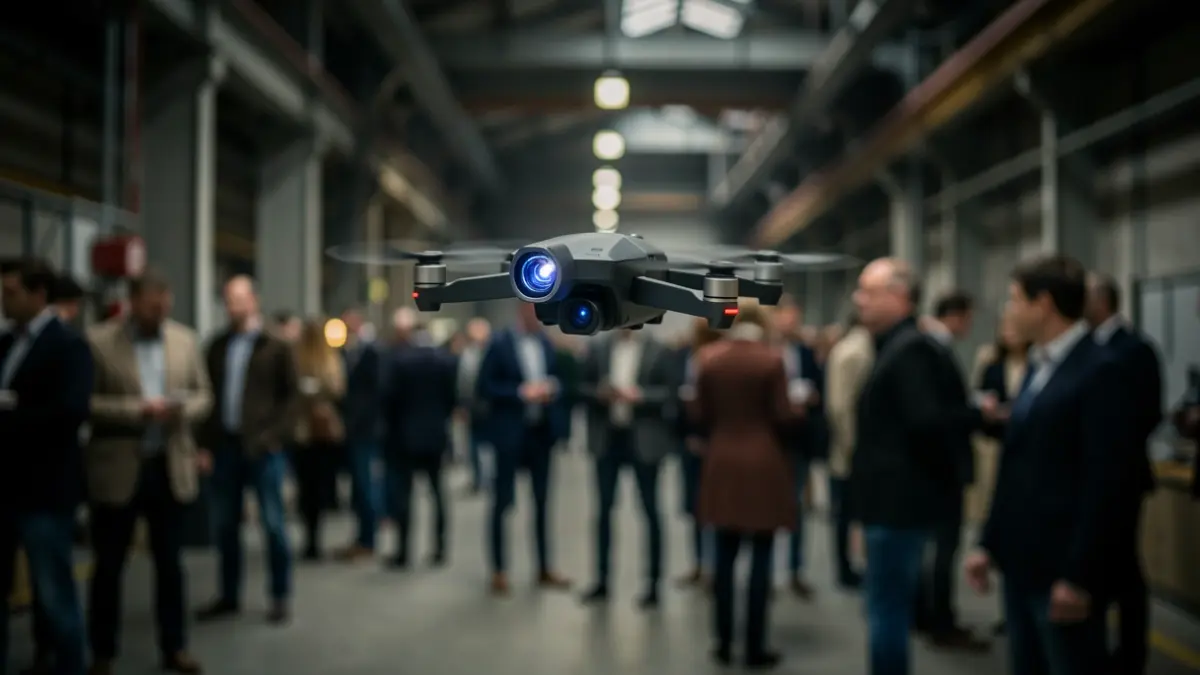
Inspired by the navigational prowess of bees, autonomous robotic drones have been equipped with a system that allows them to return to their base in complex environments, even without GPS access. This advancement, developed by specialists at Delft University of Technology in the Netherlands, could facilitate surveillance, inspection, and rescue missions in hard-to-reach areas such as greenhouses, tunnels, or industrial settings.
The system, named Bee-Nav, mimics the 'learning flights' of bees. During an initial flight around their starting point, an omnidirectional camera captures environmental images. A small neural network processes this data to create a 'home vector,' an invisible guide pointing back to the base. This method is remarkably efficient, requiring minimal memory (3.4 kB and 42.3 kB) and operating on low-power hardware like a Raspberry Pi 4.
Tests have demonstrated a high success rate: drones returned within 0.5 meters of their origin in 100% of flights up to 110 meters, and achieved a 70% success rate on journeys up to 600 meters, even in strong winds. This approach requires significantly less memory than traditional high-precision map-based methods, paving the way for low-power missions on lightweight platforms.
The new strategy is promising for robots that need to return to a base for recharging or data transfer, as well as for robot swarms dedicated to monitoring crops or inventories. However, the current system is designed for a single return location and still needs to address obstacle avoidance and navigation in more dynamic environments.