
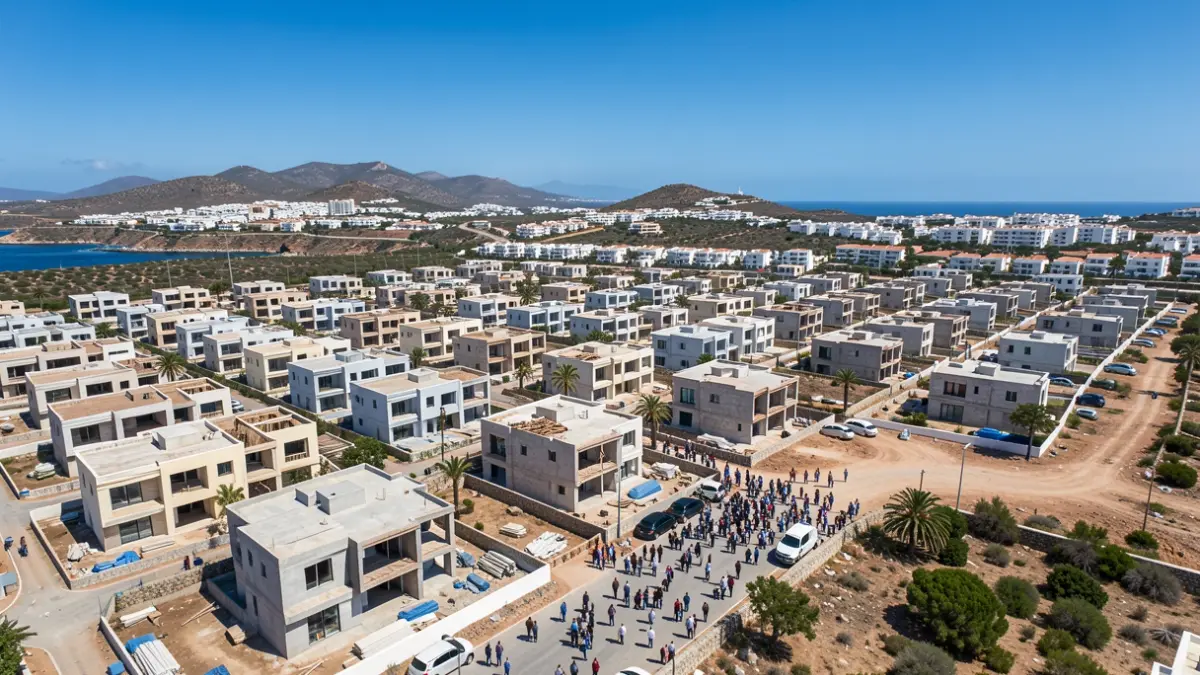
This figure places the Canary Islands among the autonomous communities experiencing growth in their stock of new construction awaiting buyers. The total number of completed homes without owners across Spain stands at 452,670, according to the Ministry of Housing and Urban Agenda (MIVAU), marking a slight decrease of 0.57%.
The MIVAU report reveals varied trends across different regions. While some areas have significantly reduced their inventory of unsold new homes, the Canary Islands have seen a 2.46% rise compared to 2024. The Islands account for 6.6% of the national stock, with 30,055 units. The proportion of these homes relative to the total residential stock in the Canaries reaches 2.7%, exceeding the Spanish average of 1.67%.
This increase is particularly striking in a territory where housing affordability and availability have become major social and economic concerns.
The problem is not confined to major peninsular urban centers or traditional real estate expansion zones.
In the provincial analysis, Santa Cruz de Tenerife stands out among provinces with the highest ratio of unsold new homes to the total housing stock, reaching 3.46%. It is surpassed only by Castellón (4.85%), Toledo (4.67%), La Rioja (4.17%), and Lleida (3.67%).
Nationally, the stock of unsold new construction ended 2025 at 452,670 units, a 0.57% decrease from the previous year. This decline follows two consecutive years of increases (0.71% in 2023 and 1.7% in 2024), breaking the absorption trend observed since 2010.
Four autonomous communities hold over 60% of the national stock: Catalonia (85,478 homes), Andalusia (68,897), Madrid (66,627), and the Valencian Community (62,632). The largest annual increases were recorded in the Balearic Islands (+9.52%), Madrid (+6.53%), and Aragon (+2.62%), in addition to the Canary Islands (+2.46%). Conversely, Murcia (-12.21%) and Galicia (-11.76%) led the decreases.
Regarding provinces, Segovia (+30.36%) and Málaga (+27.65%) experienced the most significant increases. In absolute terms, Madrid (14.72%), Barcelona (11.55%), and Alicante (5.55%) are the provinces with the largest share of the national total.