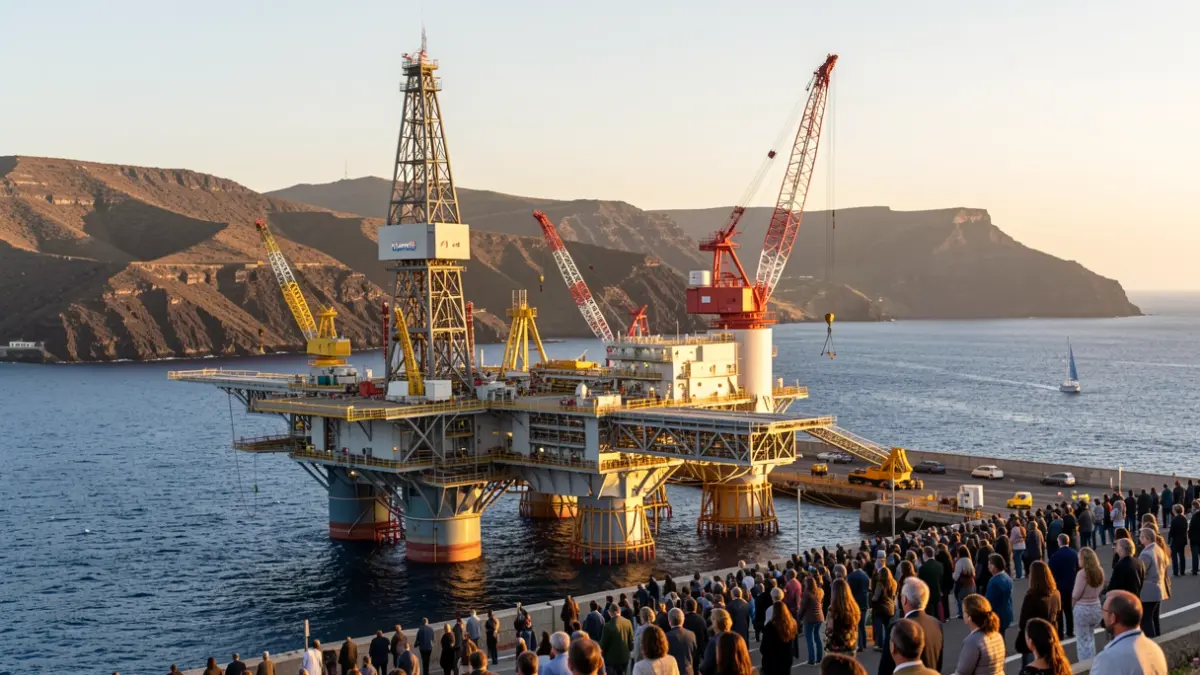
The capital of Lanzarote has, for the first time, welcomed a drilling unit specialized in offshore operations, the 'Noble Globetrotter I'. This vessel will undertake a prolonged technical stay at the Los Mármoles quay, representing a significant advancement in diversifying the island's maritime activities.
The presence of this vessel, designed for deep-water operations and complex environments, makes Arrecife the setting for an unusual operation within Canary Islands ports. For several weeks, the ship will carry out logistical and technical work following the completion of its latest international campaign in the Black Sea, with a prior stop in Turkey.
The 'Noble Globetrotter I', belonging to the international company Noble Corporation, measures 189 meters in length and 32.2 meters in beam, with a gross tonnage of 35,676 GT. It was built in 2011 and sails under the flag of Liberia.
During its stay, the platform will undergo maintenance tasks and minor afloat repairs, in addition to receiving fuel, materials, and provisions. A crew change will also take place, and specialized auxiliary services will be mobilized to meet its operational demands.
The logistical management of this complex operation is handled by the company Hamilton y Cía., which coordinates the necessary resources for the drilling vessel's stay. The docking maneuver required the assistance of two tugboats due to the unit's dimensions, positioning it along an approximately 225-meter berthing line on the pier extension to minimize impact on regular port activities.
This stop highlights the potential of the Port of Arrecife to expand its services beyond cargo and passenger transport, venturing into the offshore sector. The president of the Port Authority of Las Palmas, Beatriz Calzada, emphasized the port's operational capacity to handle technically complex projects, thereby strengthening its competitive position in international maritime markets.
The presence of the 'Noble Globetrotter I' also stimulates activity for local and archipelago-based companies linked to the maritime and port sector, generating demand for fuel, transport, provisioning, and crew services, thus reinforcing the role of ports as logistical hubs.