
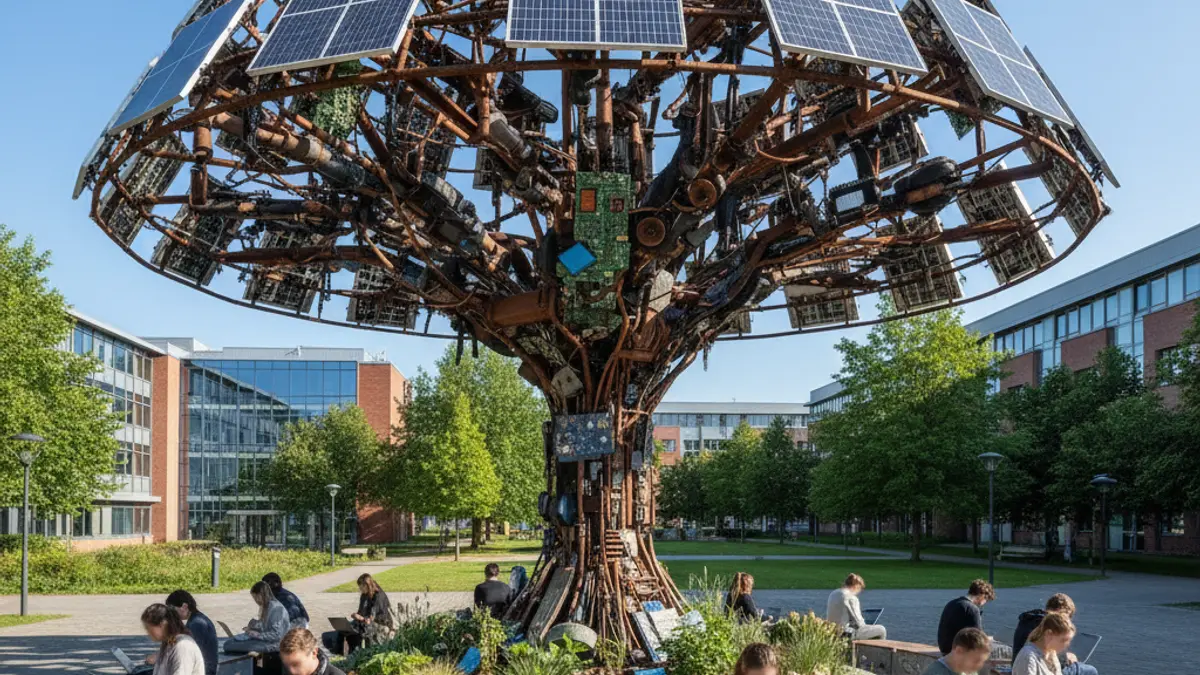
This initiative, which repurposes industrial and mining scrap materials from the region, aims to transform campuses into greener and more functional environments. The project aligns with circular economy principles, giving a second life to materials, and contributes to the institution's energy independence.
“"It is not simply a new construction, but the materialization of a vision: to transform our campuses into greener, more functional, and more inspiring spaces."
The 'biotechnological tree' integrates bifacial photovoltaic modules, whose behavior is studied using artificial intelligence techniques. These modules can capture solar radiation from both sides, optimizing electricity generation. The supporting structure has been built with materials previously used for mine shoring, reinforcing the circular economy concept.
Located in an underutilized space on the Linares campus, the project offers outdoor work areas equipped with internet access and charging points for electronic devices and electric bicycles. Additionally, it features plantings expected to colonize the structure, creating a pleasant environment conducive to the exchange of ideas among students and faculty.
The Mobilete project, part of the Ecological Transition and Digital Transition Projects call, is the result of collaboration between photovoltaic solar energy and artificial intelligence research groups from the UJA, with the participation of a third architecture group from the UMA. Similar infrastructures have been installed on the Jaén and Linares campuses, both with monitoring systems to analyze their long-term performance.