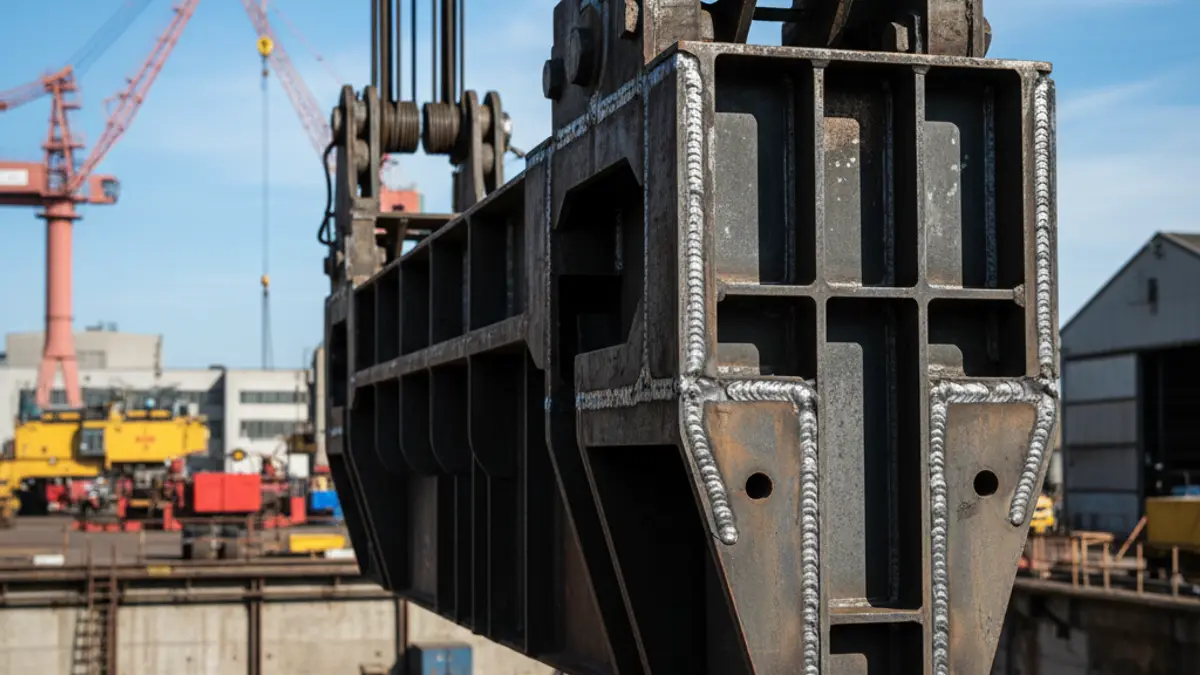
Last week, Navantia Puerto Real proceeded with lowering the 300 macrostructure of the Underwater Intervention Maritime Action Ship (BAM-IS) into the dry dock. This action continues the construction strategy for this vessel, contracted by the General Directorate of Armament and Material (DGAM) for the Spanish Navy.
The macrostructure, consisting of three blocks and weighing 597 tons, is designed to house the Voith cycloidal thrusters, whose installation is planned for the near future. It will also include the pedestal for the high-capacity crane, the organic hyperbaric chamber, and the work deck, where the underwater intervention equipment will be installed.
The new BAM-IS is set to replace the Rescue and Salvage Ship Neptuno, becoming the specialized platform for submarine support and rescue, as well as the main Navy unit for diving operations support. Its acquisition addresses a need associated with the S-80 submarines to ensure the safety of their crews.
This vessel will be capable of transporting a rescue mini-submarine and performing underwater explorations and interventions with remotely operated vehicles down to 3,000 meters deep. Its capabilities include underwater intervention with gas mixtures at great depths, submarine repairs, search and location of submerged objects, and hyperbaric treatment for diving accidents.
The BAM-IS will be the first Navy vessel with MOSHIP certification to act as a mother ship for the NATO Submarine Rescue System (NSRS) and the United States' Submarine Rescue Diving and Recompression System. Its versatile design, with a work deck exceeding 400 m², allows for the integration of modular systems for various missions.
The construction of this vessel generates approximately 1,100 jobs, of which 160 are direct Navantia employees, 300 are from collaborating industries, and 660 from subcontractors. The project is estimated to contribute an annual direct and indirect added value of around 54 million euros to the economy, with an aggregate demand of 159 million euros annually.