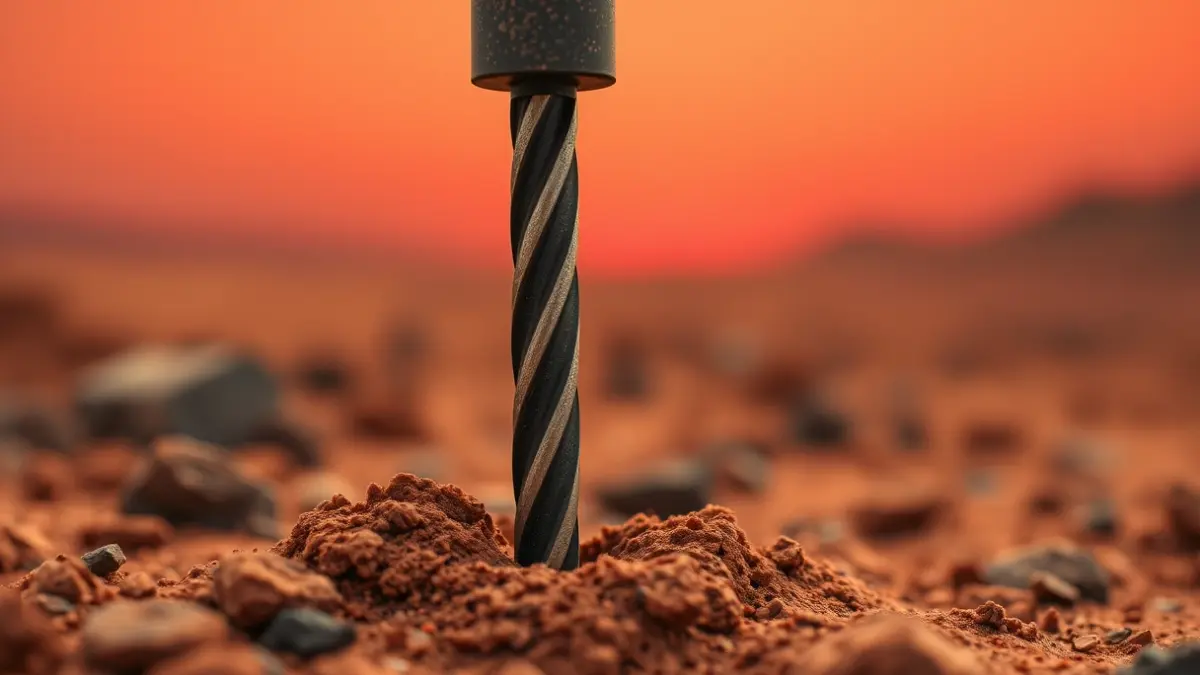
A piece of the knowledge generated in Almería will travel to Mars in 2028, directly influencing decisions on drilling the Martian soil. The ExoMars mission, with the Rosalind Franklin rover, will use insights developed in the province to identify points where to search for signs of past life beneath the surface.
Much of the information the rover will analyze on Mars has been previously identified, tested, or trialed in Almería. Various teams have worked with minerals, soils, and structures that serve as references for interpreting the Martian terrain, in a process ranging from field discovery to its application in a space mission.
One of the most significant contributions is the mineral jarosite, first described in the province. Its detection on Mars by NASA in 2004 was crucial, as this mineral only forms in the presence of acidic liquid water. This discovery reoriented Martian exploration, confirming the past existence of water and directing research towards areas with the potential to have harbored life.
The Tabernas Desert has been a key setting for testing rover operations. In this environment, drilling, sampling point selection, and material analysis have been carried out, following the same protocols that will be applied on Mars. These tests include simulating communication delays to replicate working conditions millions of kilometers away.
The connection to Mars is not limited to the surface. In Alhama de Almería, a drilling operation up to 500 meters deep is planned to analyze a possible impact structure, which will provide data for understanding Martian craters. The analysis of materials and geological layers in the province helps interpret what the rover will find underground.
The Rosalind Franklin rover has experienced multiple delays since its initial planning in 2018, due to technical, logistical, and political issues. The COVID-19 pandemic and the breakdown of cooperation with the Russian agency Roscosmos in 2022, following the invasion of Ukraine, forced a redesign of the project and the search for new partners, postponing the launch until at least 2028.