
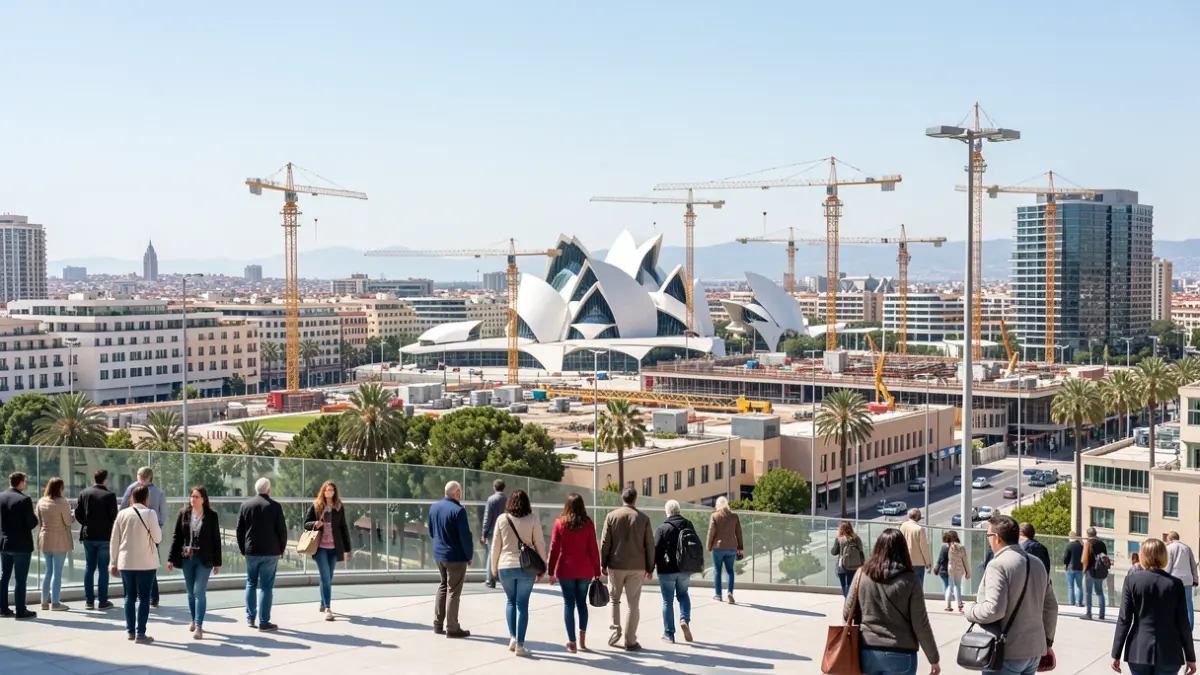
Valencia is experiencing one of its most attractive moments for real estate investment. The city has become a focal point for national and international funds to initiate new projects, in both the residential and tertiary segments, due to its demographic growth, quality of life, and industrial potential with more affordable prices than mature markets like Madrid or Barcelona. However, this 'appetite' faces two main obstacles: the scarcity of land in the 'Cap i Casal' (city center) and the deficiencies in metropolitan transport that hinder capital from reaching certain municipalities lacking good connections. This was highlighted during the conference 'Invest, Develop, and Transform: The Future of Large Real Estate Projects', organized by Simetría Grupo and Valencia Plaza.
This dilemma has sparked debate on where the Capital of the Turia should grow to absorb the significant market demand. The lack of land is causing a severe supply problem, which experts warn will worsen if not resolved. In this scenario, developers, investors, and urban planners have called for greater administrative agility and a metropolitan vision to address the current residential deficit and the growing interest in space for new economic activities.
Valencia has put itself on the map.
This was highlighted by José Luis Palau, Development Area Director at Simetría Grupo, who explained that the city has transitioned from a model primarily based on local developers and traditional housing linked to urban growth to becoming an attractive destination for institutional capital. Palau recalled how years ago it was difficult to convince investors, who saw the city as just a beach destination, whereas now funds are reserving resources to invest here. Numerous Valencian business representatives attended the event, including Gabriel Alberto Batalla Reigada, president of Simetría Grupo.
Palau argued that housing needs have evolved and are no longer limited to conventional housing, citing the need for new formats like 'living'. Simetría Grupo, he explained, is directing part of its activity towards student residences or 'flex living', such as the projects promoted on Avenida de los Naranjos (Nido Malvarrosa) and a new joint initiative with Atitlan in Cabanyal that will add nearly 700 rooms in 'flex' format.
The day the Grau is developed, it will give the impulse it needs to become the jewel of the Mediterranean.
Roberto Centeno, president of Atitlan, agreed that the main problem is not a lack of capital, but finding and advancing projects. He highlighted Valencia's transformation since the end of the real estate boom and valued Atitlan's commitment to large projects like the tertiary development of Nou Mestalla or the Grau PAI, which he considers key for the city's future.
Javier Faus, CEO of Meridia Capital Partners, recalled that Valencia is now on the radar of major European institutional investors. The Valencian capital has gained relevance in recent years, and Meridia Capital manages over 3 billion euros in various real estate segments. He highlighted the logistics project developed in Aldaia.
Urban planner Alejandro Escribano, considered the father of Valencia's 1988 General Plan, painted a complicated picture if urgent action is not taken. He warned that residential reserves are practically exhausted, estimating a deficit of around 17,000 homes and only availability for about 8,000 new units in pending developments. 'My diagnosis is that the land has run out,' he stated, emphasizing that 'the only possible expansion lies in the metropolitan area and improving public transport connections'.
The common concern during the meeting was housing. Population increase, the rise of new demand profiles, and the scarcity of available product explain the market tension. José Luis Palau estimated around 3,000 available homes for over 50,000 students seeking accommodation, a ratio of 25 people per home. Valencia needs to build between 5,000 and 6,000 homes annually, a figure far exceeding current production.
The need for decisions both within the city and its metropolitan area was a clear call. 'It is evident that where there have been good communications, growth has worked,' affirmed Palau, citing municipalities like Torrent, Mislata, Quart de Poblet, or Paterna as examples of urban integration.
Roberto Centeno warned of the risk of exacerbating the housing emergency if no action is taken. 'The metropolitan area is where the opportunity lies,' he stated, pointing out that the lack of product could lead to social conflict. The solution involves overcoming the capital's administrative boundaries and leveraging the potential of surrounding municipalities. Alejandro Escribano advocated for a strategy based on well-connected metropolitan corridors via public transport and the urgency of mobilizing large land banks, even proposing expropriations similar to those for industrial land in Parc Sagunt.
Transport was identified as another major pending issue. Javier Faus criticized the lack of investment in metropolitan mobility, prioritizing high-speed rail over daily commuting. 'If the metropolitan area had real transport, the housing problem would be very different. It's not about kilometers, but minutes,' he stated. Faus also warned of the risk of Valencia becoming a 'Venice' dominated by tourism, losing its authenticity.
Beyond housing, participants alerted to the issue of taxation, with taxes accounting for 20% to 30% of a home's price. Lengthy administrative procedures and the cumbersome regulatory framework were also highlighted as obstacles. Calls were made for more agile procedures and greater coordination between administrations to accelerate both residential and industrial developments.
The overall conclusion is that Valencia is experiencing a golden age with significant investment activity and demand. However, the challenge is immense, and the question remains whether it will be able to generate the land, infrastructure, and planning necessary to support this growth.