For decades, descriptions of ecosystems like the Amazon rainforest, African savanna, or Arctic tundra have relied on a simplified view of plants. However, their organization into communities – who lives next to whom and in what proportion – is fundamental to determining an ecosystem's capacity to adapt to droughts or heatwaves, or its vulnerability to these phenomena.
The research, published in Nature Communications, was led by the Signal and Image Processing (ISP) group at the University of Valencia (UV). It involved 13 institutions, including the Max Planck Institute, NASA, and the universities of Leipzig and Freiburg. Over a billion georeferenced observations from GBIF, the leading biodiversity citizen science platform, were processed.
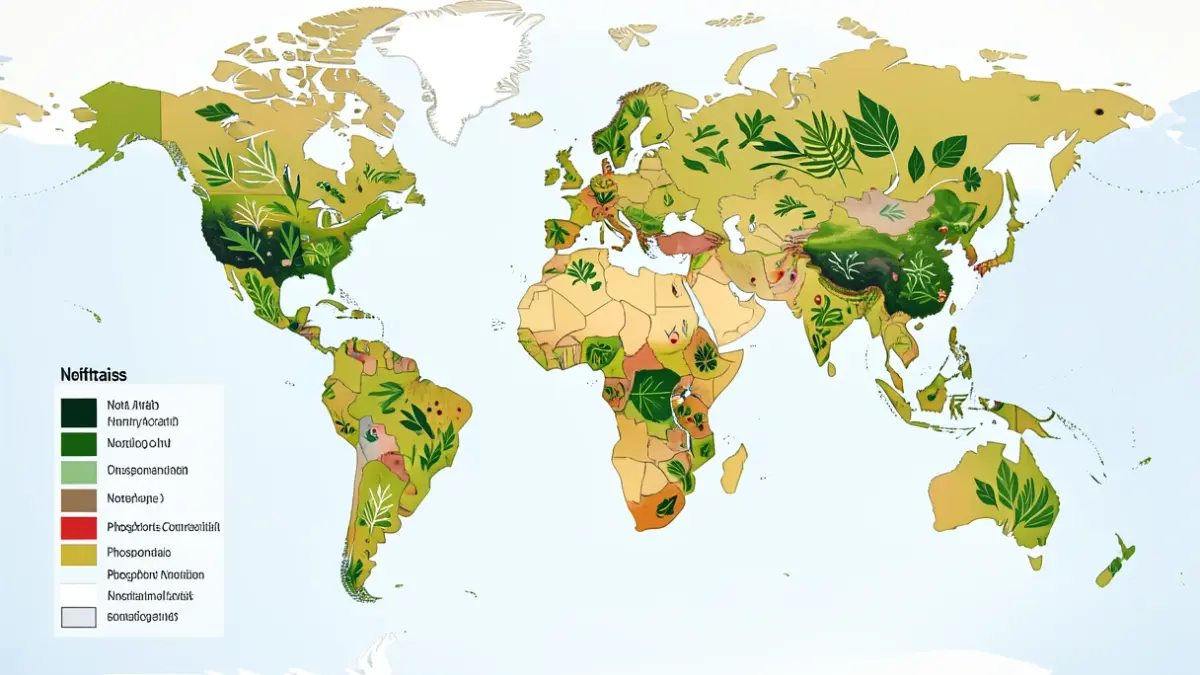
The work generates high-resolution global maps of three key leaf traits: specific leaf area (SLA), nitrogen concentration (LNC), and phosphorus concentration (LPC). These traits influence CO2 capture, water regulation, and heat response. The novelty lies not just in having a typical value per ecosystem, but in understanding the distribution of these traits within the plant community, i.e., whether very different or very similar plants coexist.
“"A single reference value is just the starting point. What determines whether an ecosystem can adapt and react to drought or heatwaves, or if it is vulnerable to them, is how its plants are organized as a community: how much diversity there is among them, who can withstand the extremes. And that is exactly what we can now map globally."
Álvaro Moreno-Martínez, a Ramón y Cajal researcher at IPL-UV and lead author of the study, notes that climate models have treated vegetation too simplistically. "For the first time, we have a quantitative and global description of how plant communities are actually organized, which will substantially improve our ability to predict and understand how the biosphere will respond to climate change," he states.
To achieve this, the team processed over a billion georeferenced observations and combined them with functional traits from more than 250,000 species from the TRY database. Satellite imagery was also used to estimate local vegetation composition with a precision of one kilometer.
Jordi Muñoz-Marí, an IPL-UV researcher and co-author, points to the computational and conceptual challenge of handling so many observations. José E. Adsuara, also an IPL-UV researcher and co-author, highlights that the combination of field ecology, remote sensing, and machine learning has been key to transforming millions of observations into globally meaningful patterns.
The Valencian core of the work, consisting of Álvaro Moreno-Martínez, Emma Izquierdo-Verdiguier, Jordi Muñoz-Marí, José E. Adsuara, and Gustau Camps-Valls, has extensive experience in artificial intelligence and remote sensing applied to understanding the Earth system. The maps are open access and available on platforms like Google Earth Engine.