INNOCUA tests advanced technologies for water purification in Paterna
The project, involving several Valencian institutions, evaluates six treatments to eliminate emerging contaminants.
By Empar Soler i Martí
••3 min read
IA
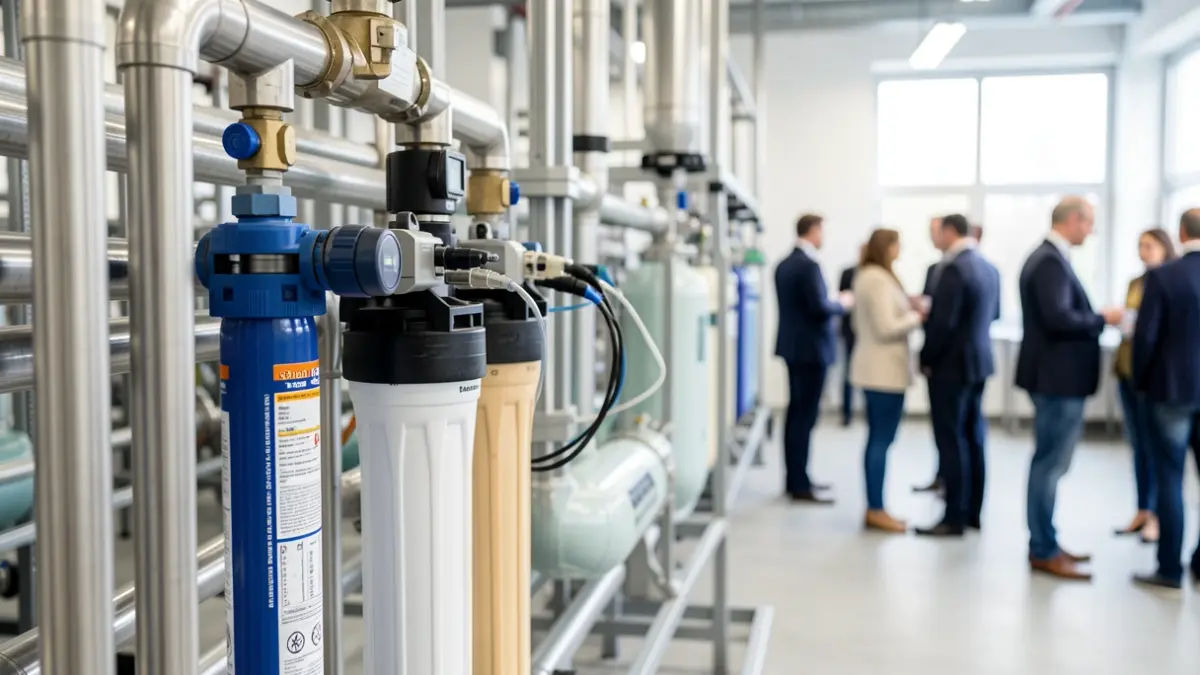
Generic image of water treatment technology.
The INNOCUA project is evaluating six advanced treatment technologies at the Wastewater Treatment Plant (WWTP) in Paterna to eliminate emerging contaminants that conventional treatment plants cannot fully retain.
Water management faces the challenge of eliminating emerging contaminants such as microplastics, pharmaceutical compounds, pesticides, or resistant bacteria, which conventional treatment plants do not fully retain. To address this need, the INNOCUA project has been launched, testing new technologies at the Paterna WWTP (Valencia).
This initiative, driven by a consortium led by Labaqua and involving AIMPLAS, Aigües de Paterna, the University of Valencia, and the Polytechnic University of Valencia (CALAGUA group), along with Calpech, aims to develop and validate advanced solutions to ensure health and environmental safety in the reuse of wastewater.
The project evaluates six quaternary treatment technologies: photocatalysis, activated carbon adsorption, ultrafiltration, and iron nanoparticles at pilot scale, as well as ozonation and ultraviolet radiation at industrial scale in Paterna.
“
"The project adopts an integral approach based on the “One Health” concept, which considers the interrelationship between human, animal, and environmental health. For this purpose, advanced genetic analysis techniques, such as metagenomics, are used to better understand the risks associated with antimicrobial resistance and develop more effective strategies for its control in the water cycle."
INNOCUA aligns with the new European Directive on Urban Wastewater Treatment (2024/3019), which will require quaternary treatments in large treatment plants. The project seeks to anticipate these requirements through adapted solutions.
“
"The possibility of validating these technologies in a real environment like the Paterna WWTP is fundamental to verify their viability. From Aigües de Paterna, we contribute the operational perspective and facilitate the integration of these solutions under real operating conditions."
At pilot scale, work is being done with photocatalysis, activated carbon adsorption, ultrafiltration, and iron nanoparticles to improve the removal of complex contaminants.
“
"Our work focuses on developing photocatalysis-based solutions and generating microplastic patterns that allow for precise evaluation of treatment efficacy. This is key to advancing technologies capable of removing contaminants that have been very difficult to treat until now."
“
"Ultrafiltration is one of the key technologies for improving the quality of regenerated water. In the project, we are working on its optimization to maximize contaminant removal while ensuring process efficiency."
“
"They represent an innovative solution with great potential for the removal of complex contaminants. Their application in this project allows exploring new avenues to improve the effectiveness of advanced treatments."
INNOCUA also evaluates the economic viability and environmental impact of the technologies through cost and life cycle analyses, to quantify the investment and the carbon footprint for large-scale implementation.
“
"To this end, cost cycle analyses (CCA) and life cycle analyses (LCA) are being developed, which will allow quantifying both the necessary investment and the carbon footprint associated with their large-scale implementation."
Currently, the project is in the operation phase with real water at the Paterna WWTP, monitoring the performance of pilot equipment and industrial-scale treatments. INNOCUA aims to advance towards a safer and more sustainable treatment model, facilitating water reuse with greater guarantees.
The project is funded by the Valencian Institute of Competitiveness and Innovation (IVACE+i) and the European Union's FEDER funds.