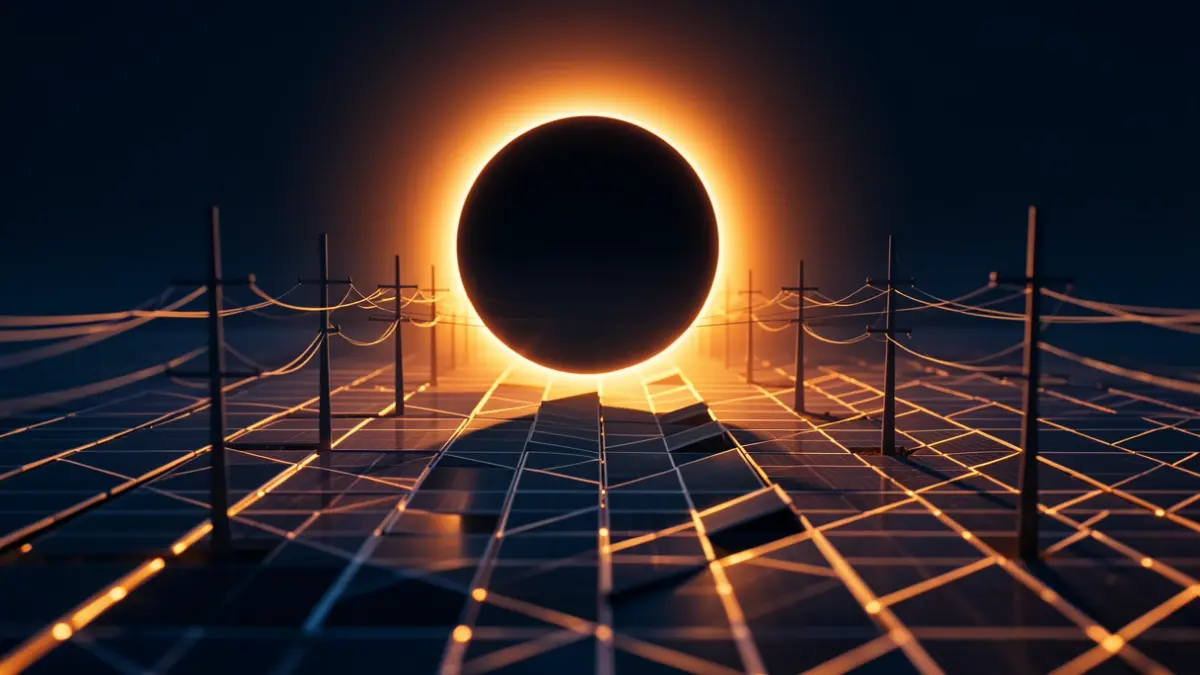
While millions will watch the solar eclipse on August 12, Red Eléctrica will focus its attention on the electrical grid. The moon's partial coverage of the sun will reduce solar radiation, affecting energy generation from solar panels, which could drop to near zero during the minutes of greatest darkness.
The system operator has developed a mathematical model to calculate the generation loss, estimated at around 5 gigawatts (GW) at peak impact, equivalent to 13% of the maximum demand on a typical August Wednesday. The final outcome will depend on the day's weather; a cloudy sky will lessen the effect, while a clear sky will accentuate it.
A favorable circumstance is that the eclipse will occur at dusk, between 7:30 PM and 9:30 PM, coinciding with the natural decrease in solar production. Furthermore, it does not align with peak summer consumption hours, and the totality phase will last only between one and two minutes. According to Ricardo Bajo, director of operations services at Red Eléctrica, the impact will be limited on the peninsular system and even more reduced in the Canary Islands and Balearic Islands.
To prevent any issues, Red Eléctrica will activate preventive measures, including enhanced coordination with official bodies, European electricity operators, and national generation and distribution control centers. They will also increase safety reserves and continuously monitor the eclipse's progression.