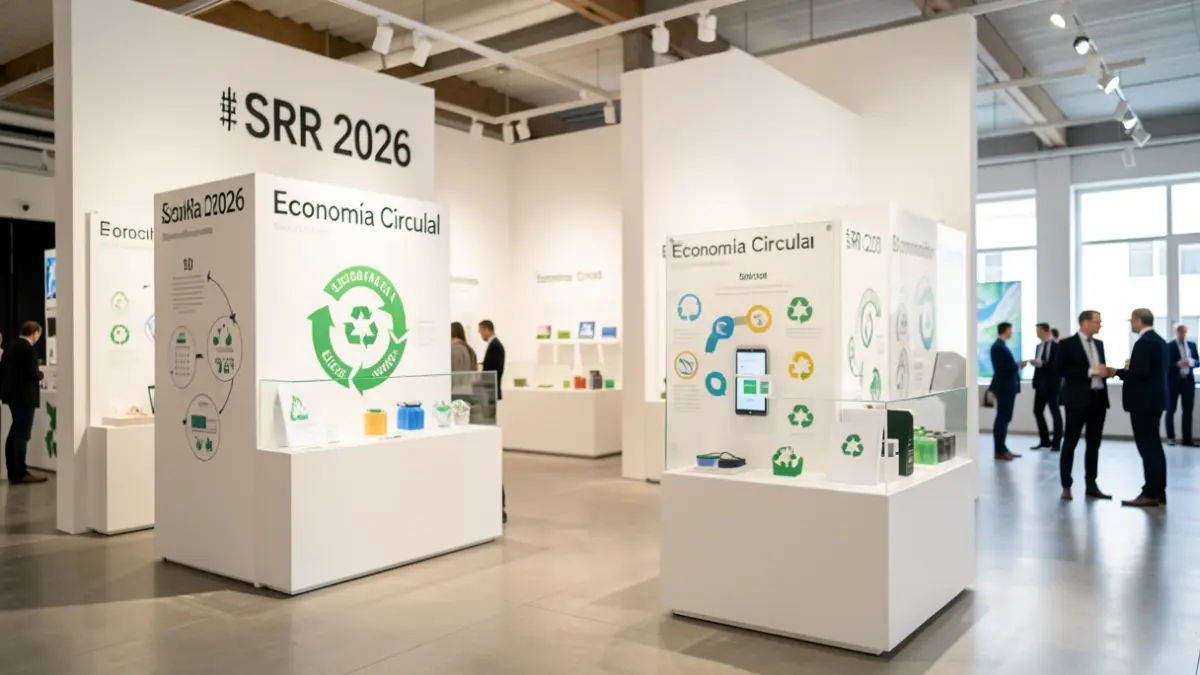
The International Recovery and Recycling Fair (SRR), considered Spain's premier event in the circular economy sector and promoted by the Spanish Federation of Recovery and Recycling (FER), will hold its 2026 edition from June 9 to 11 at IFEMA MADRID. This event highlights the sector's transformation, where the circular economy has shifted from an aspiration to a mandatory regulation for businesses.
A notable new feature of SRR 2026 is the introduction of a dedicated space for SCRAPs (Collective Systems of Extended Producer Responsibility). These systems are positioned as strategic players in the new production model, redefining product manufacturing, payment, and design under circular economy principles.
SCRAPs serve as the primary mechanism through which most packaging companies fulfill their waste management obligations. The principle of Extended Producer Responsibility (EPR) shifts the burden of managing product waste at the end of its useful life onto the producers. This principle, first introduced in Spain in 1997, has progressively expanded to cover more waste streams, most recently with Royal Decree 1055/2022, which extends EPR to commercial and industrial packaging.
For companies, managing packaging waste is no longer a strategic decision tied to sustainability but a legal requirement with quantifiable targets and penalties for non-compliance. Collective compliance, through adherence to a SCRAP, is the majority option, allowing companies to delegate the organization, financing, and traceability of packaging management without needing to establish their own systems, ensuring compliance under a supervised and audited framework.
At the SCRAPs Area of SRR 2026, six representative systems for different waste streams will be present, including Ecoembes. Joining a SCRAP means more than just legal compliance; it provides a specialized partner that handles the technical and administrative complexities of waste management, freeing up internal resources and guaranteeing regulatory compliance traceability. It also offers access to ongoing advice on evolving regulations and eco-design tools to reduce environmental impact from the initial product conception.
Consequently, this directly contributes to the circular economy by ensuring materials re-enter the production cycle, packaging is designed for reuse, and companies integrate sustainability into their business models. SCRAPs are proving to be key instruments for companies to transition towards an ordered, verifiable, and sustained circular economy.
Hall 7 at IFEMA MADRID will serve as the venue to gauge the evolution of packaging waste management in Spain during SRR 2026. The presence of SCRAPs at this leading industry fair is significant, reflecting their evolution from regulatory figures to active agents of the circular economy.