The UC3M's contribution was made within the framework of an industrial doctorate funded by the Community of Madrid, in collaboration with IENAI Space, a startup linked to the Innovation, Entrepreneurship and Artificial Intelligence Centre (C3N-IA) at the UC3M Science Park in Leganés Tecnológico. The work, carried out by IENAI Space engineer Francisco José Blázquez Plaza and supervised by Professor Andrés Barrado, head of the GSEP, consisted of designing the power electronic architecture required to control and power this miniaturised motor.
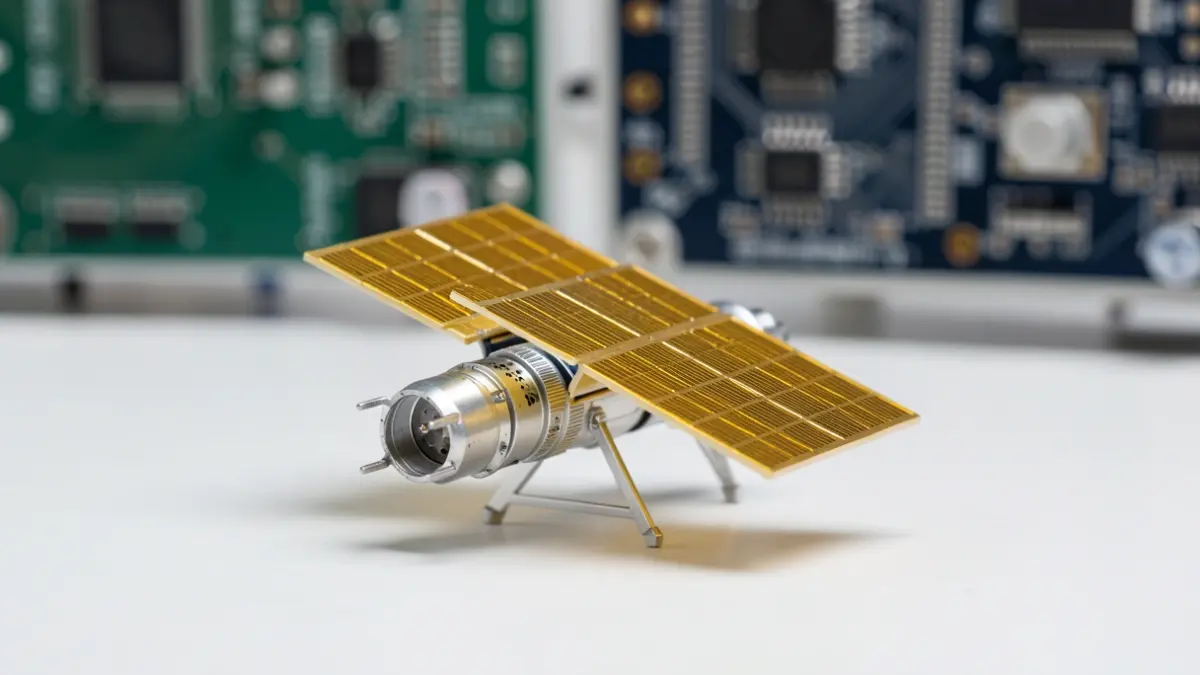
This technological advance enables small satellites to have manoeuvrability, orbital maintenance capability and collision prevention in space. Solar panels on nanosatellites supply energy at low voltage (3.3, 5 or 12 volts), whereas electrospray-based thrusters require intense electric fields and high voltages. To resolve this difference, the UC3M and IENAI team designed a high-voltage power processing unit (PPU). This device includes a high-gain converter capable of transforming low solar voltage into outputs between 1,500 and 2,000 volts, achieving a conversion efficiency of 97.6%.
“"The greatest technical challenge has been to develop power electronics capable of multiplying the input voltage by more than two hundred in a very reduced volume and weight, guaranteeing absolute stability in the demanding conditions of the space environment, and obtaining very high efficiency."
The launch of the FOSSA Systems satellite (6U format platform) took place aboard a SpaceX Falcon 9 rocket, as part of the Bandwagon-5 mission, from Cape Canaveral (Florida). This event marks the start of in-orbit validation tests for the system. The incorporation of this electric propulsion technology in small satellites extends their useful life, optimises positioning in communications constellations and promotes space sustainability by facilitating evasion and deorbiting manoeuvres at the end of the mission.
The doctoral thesis titled High Voltage Power Processing Unit with Dual Symmetrical and Variable Output For Space Thrusters Based on Electrospray Technology was defended by Francisco José Blázquez Plaza in July 2026, under the supervision of Andrés Barrado.