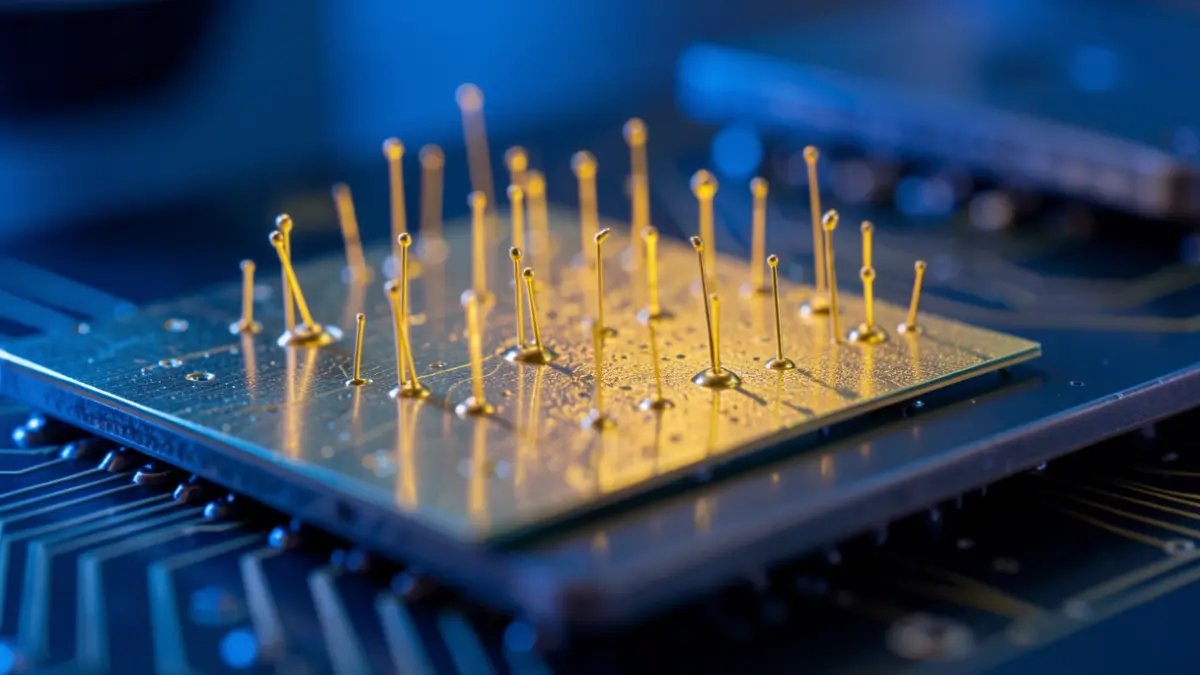
The study, published in Nano Letters on November 24, 2026, details how reversible and localised manipulation of metal-insulator transitions has been achieved without direct electrical contact. To this end, the researchers used arrays of star-shaped gold nanoantennas, which act as nanoscale energy concentrators under near-infrared illumination.
These nanoantennas induce highly confined phase transitions through near-field electromagnetic enhancement and photothermal effects. Electromagnetic simulations revealed strong field localisation at the branches and tips of the nanoantennas, later confirmed using advanced synchrotron X-ray diffraction and confocal Raman microscopy techniques.
This spatially selective opto-thermal switching system provides a platform for light-addressable memory elements, neuromorphic computing, and low-power photonic devices. The authors of the work are Jesús López-Sánchez, Fernando Rubio-Marcos, Javier del Valle, Manuel Abuin, Fernando Ajejas, Adolfo del Campo, Jaime Dolado, Raúl Magro, Ana Espinosa, Sebastián Deniz López, Elvira M. González, Noemí Carmona, Javier González-Colsa, Beatriz Castillo-López de Larrinzar, Miguel A. García, Óscar Rodríguez de la Fuente, Antonio García-Martín and Álvaro Muñoz-Noval.