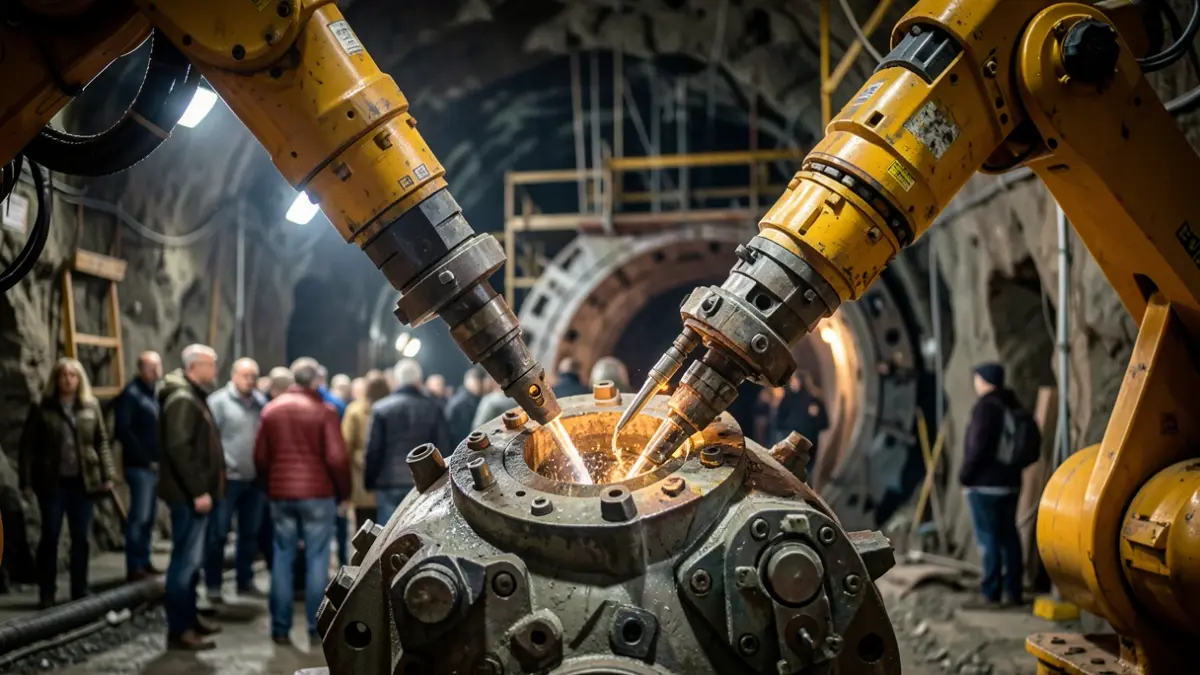
CDTI Innovación is seeking a Spanish company with its own R&D&i capabilities to participate in a technological cooperation project with China. The objective is to develop and validate intelligent machinery and systems for tunnels, mining, and other underground construction work, combining artificial intelligence, automation, robotics, sensors, and advanced control systems.
The new generation of equipment will need to collect environmental data, interpret it, and adapt its operation. The project will focus on terrain perception and adaptive drilling systems to detect rock characteristics and adjust working parameters based on encountered conditions, allowing for more flexible responses to changing environments.
Another project line focuses on automating drilling and blasting processes, studying robotic equipment and control systems capable of planning and optimizing these operations. Automation is particularly useful in underground environments due to risks related to geology, visibility, or space, thereby improving safety and efficiency.
Efforts will be made to integrate and coordinate different teams, enabling various systems to share information and work collaboratively. Monitoring systems will also allow for the analysis of results and validation of prototypes, transforming individual machines into connected ecosystems.
The initiative, coordinated by Central South University with participation from the Universitat Politècnica de Catalunya, seeks a Spanish company with expertise in tunnel construction, geotechnical engineering, machinery design, automation, robotics, sensors, industrial software, and artificial intelligence applied to construction.
The proposal is set to be submitted for the eighth call for R&D projects under the CHINEKA program, planned for the last quarter of 2026. This bilateral technological cooperation program between Spain and China promotes joint projects with market prospects, combining knowledge in underground construction with engineering, AI, robotics, and advanced manufacturing.
AI is being directly integrated into industrial physical processes, enabling terrain interpretation, drilling adaptation, and machinery coordination. The industry is moving towards models where machines, sensors, software, and data work together to create safer, more precise, connected, and efficient processes.