
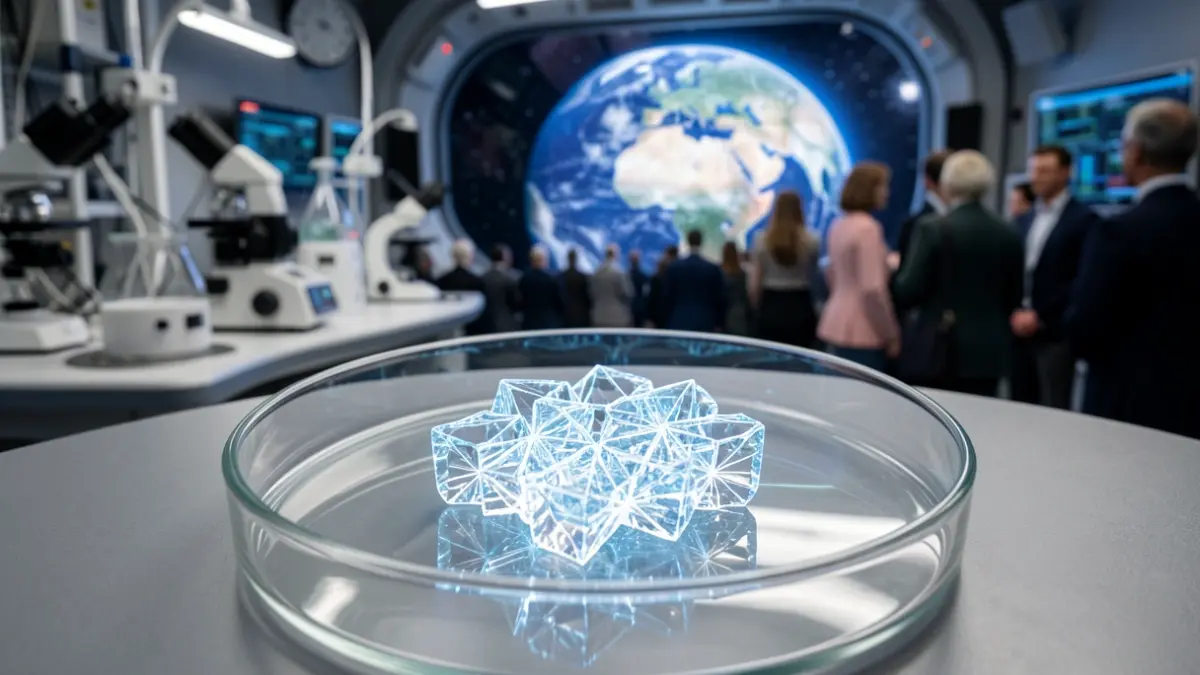
The project, the only Spanish entry to reach the final phase of the ESA's Space for Inspiration competition in 2026, explores how the absence of gravity can transform the growth of zeolite crystals, key materials used as catalysts. The initiative seeks to replicate the enhanced properties of these space-synthesized zeolites on an industrial scale on Earth, using small samples as crystalline "seeds".
Luis Gómez-Hortigüela, a researcher at the CSIC's Institute of Catalysis and Petrochemistry (ICP) and project leader alongside Joaquín Pérez Pariente, explains that space synthesis will achieve unprecedented structural precision. "We could use them as 'seeds' to replicate their improved properties on an industrial scale on our planet," he states. The team also includes Jaime Jurado and Ramón de la Serna from the same institute.
The team will investigate potential advancements in the production of enantiopure catalysts for chiral drugs and in improving catalysts for converting methanol into high-value fuels and chemicals. Microgravity, by reducing effects like sedimentation and natural convection currents, allows for more uniform and ordered crystal growth, opening possibilities for materials with properties difficult to achieve on Earth.
The primary goal is not large-scale zeolite production in space, but rather using small quantities of space-grown crystals as "seeds" to reproduce their valuable characteristics on Earth through a "inherited crystalline memory" effect. The project will send zeolite synthesis systems into space to analyze the influence of microgravity and replicate the materials in the laboratory.