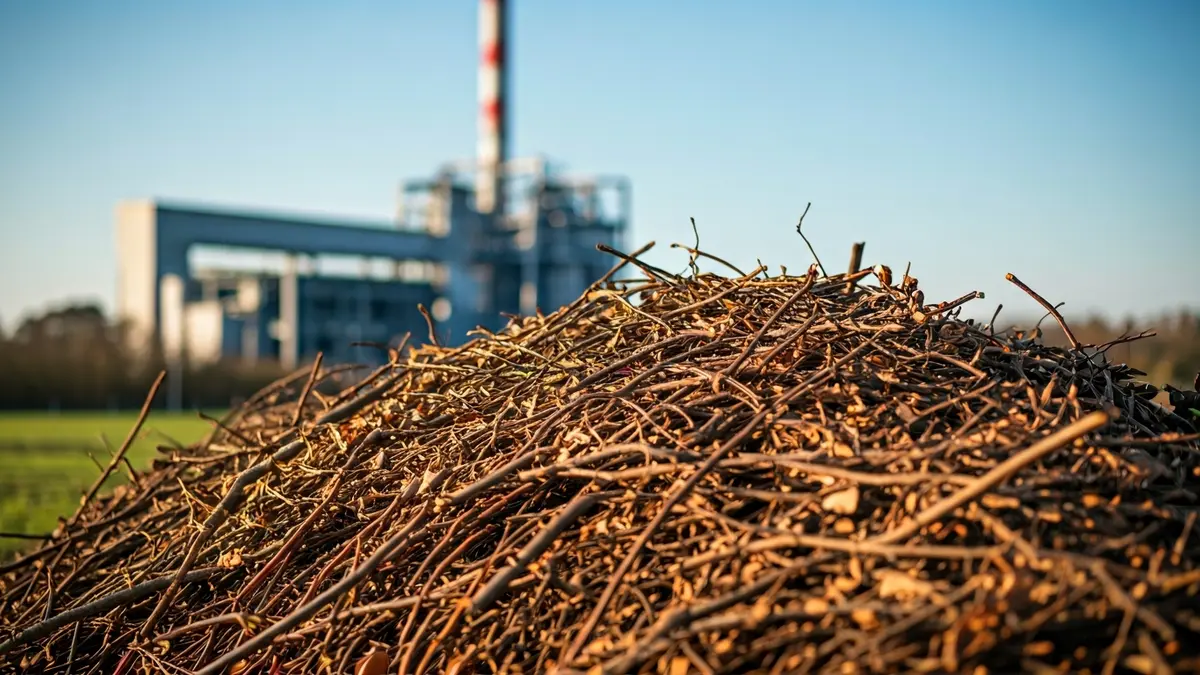
This initiative, funded by the Ministry of Science, Innovation and Universities, primarily seeks to valorize biomass from forest and road/mountain pruning waste across Spain. The key process is thermal pyrolysis, which converts these residues into high-value products like biofuels through the chemical decomposition of organic matter at moderate temperatures (between 400ºC and 600ºC) in the complete absence of oxygen.
The Pyrofuel project not only aims to reduce the risk of fires and the waste of energy and plant biomass, but also intends to increase the efficiency of thermal pyrolysis by 30%. Furthermore, this technology is expected to reduce CO2 emissions associated with fuel production processes by up to 17%.
“"The progress to be achieved with the Pyrofuel project will be thanks to adequate logistics for collecting and transporting residual biomass and thanks to the development of innovative technologies for its processing."
The research team at ITQ (CSIC-UPV), a joint center of the Spanish National Research Council (CSIC) and the Universitat Politècnica de València (UPV), is working to efficiently and sustainably obtain liquids derived from biomass thermal pyrolysis. These bioliquids are subsequently improved through catalytic hydrotreatment, a process that removes impurities and refines the final product to obtain liquid fuels similar to kerosene and diesel, suitable for aviation (SAFs) and heavy transport.
The CAT-REN research group at ITQ leads the design of new solid catalysts based on supported metals, which accelerate chemical reactions and make the process more efficient and economical. This innovation is crucial for transforming bioliquids into fuels compatible with current transport systems.
“"Thanks to our group's experience in the catalytic treatment of these and other pyrolysis liquids derived from biomass, which have been developed in previous industrial application projects such as Ceus and Almagreen, we are able to obtain improved liquids compatible with current transport fuels, such as jet-fuel and diesel."
The project, led by the company Meryt Catalysts & Innovation, is an example of public-private collaboration that brings together I2con and Neoliquid, consolidating a Spanish network focused on developing innovative solutions for a circular and sustainable bioeconomy.