The program, promoted by the UDC's Scientific Dissemination Unit, aims to bring the institution's research results closer to the public through scientific infographics. In this edition, two of the five selected projects, driven by CITEEC research staff, underscore the thematic diversity and dissemination potential of their work.
The first winning proposal, titled «When Galicia had crocodiles and hippos», comes from Alejandro Blanco Calvo and Blanca Moncunill Solé (Research Group in Environmental Change and Paleobiology - GRICA-BIOpast). The initiative focuses on the fossil record of vertebrates from the Paleogene and Neogene periods in Galicia, challenging the idea that the region lacks significant fossils and showcasing the paleontological heritage that allows reconstruction of past ecosystems. It also aims to introduce the BIOpast group's research and the use of new technologies like tomography and 3D printing in Paleontology.
A central theme of this proposal is the study within the OLIGOlife project, focusing on Oligocene and Miocene fossils in Galicia, with materials from the As Pontes mine. Findings include plant remains and fossils of animals such as mollusks, crocodiles, anthracotheres, frogs, fish, and small rodents, which help reconstruct the lacustrine and marshy landscape of a subtropical climate approximately 23 million years ago.
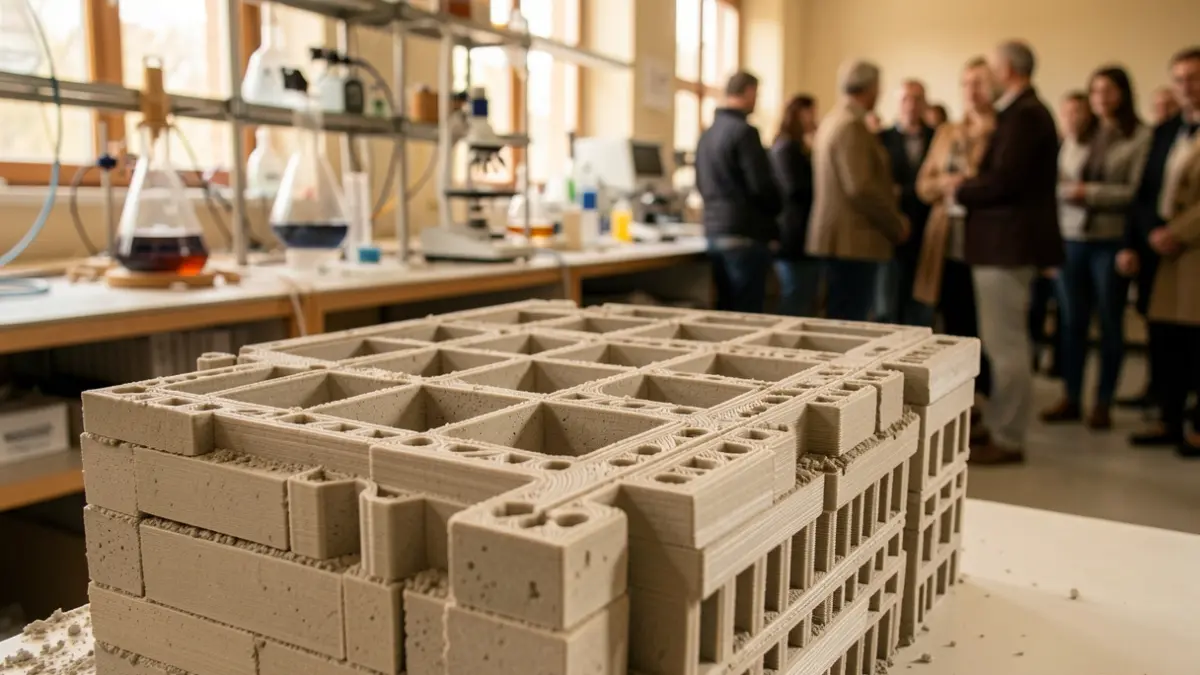
The second proposal, «Circular 3D Construction. A proposal focused on constructive innovation», is by Paloma Funes García, Belén González Fonteboa, and Sindy Seara Paz (Construction Group - gCONS). The infographic highlights the potential of 3D concrete printing for a more efficient and environmentally friendly construction model. Concrete, one of the world's most used materials, generates about 8% of global CO₂ emissions, and 3D printing offers ways to reduce construction's environmental impact by manufacturing elements layer by layer, thus reducing timelines, costs, waste, and labor risks.
The main technological challenge lies in developing mixtures with suitable properties for printing. Within the Eco3DConcrete project, the gCONS group is working on partially substituting cement with alternative materials like ash and sand from Galician forest biomass, turning waste into raw materials. These results allow for a 35% reduction in the mixture's equivalent CO₂ emissions, promoting more sustainable building.