
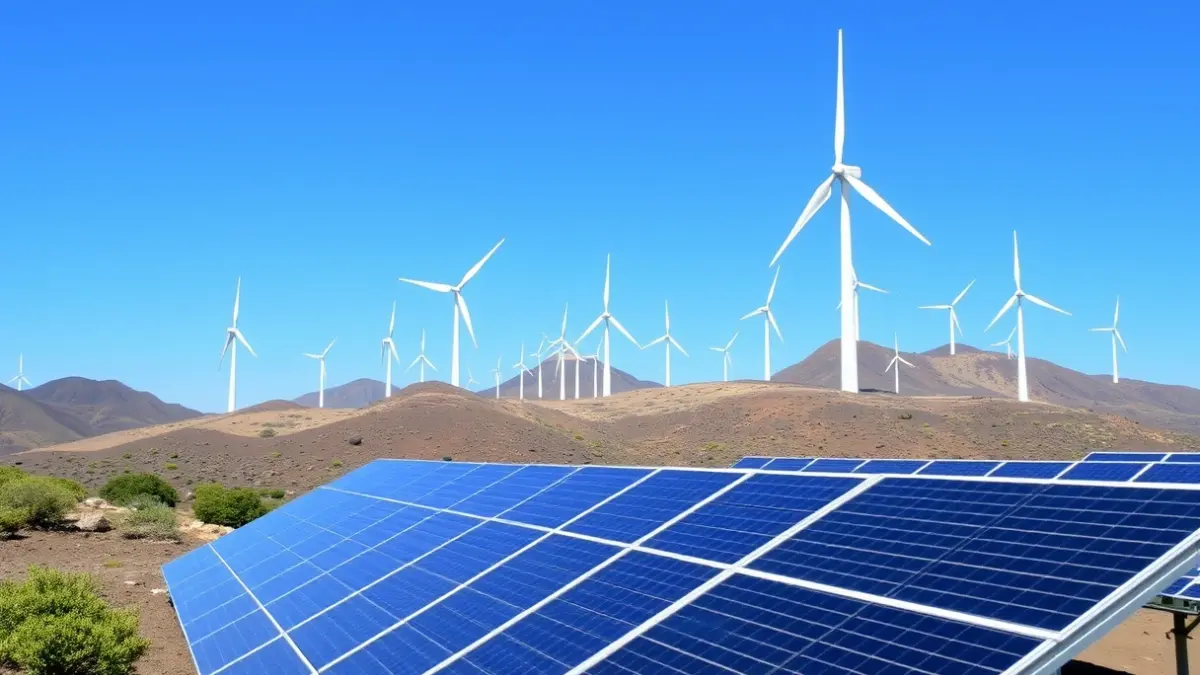
The intermittency of renewable energies, such as solar and wind, poses a significant challenge to their integration into the electricity system. To counteract this, a study proposes a counter-intuitive solution: installing solar panels and wind turbines in locations that, while not the most productive on average, generate electricity when areas with greater natural resources do not.
This methodology, called “spatio-temporal complementarity,” seeks to ensure that electricity generation matches demand, avoiding imbalances caused by peaks and troughs in renewable production. According to the research, the current mismatch in the Canary Islands could range between 40% and 50% if the current pattern of photovoltaic and wind farm placement is maintained.
Scientists from the University of Murcia (UM) and the Earth and Atmosphere Observation Group (GOTA) of the University of La Laguna (ULL) have analyzed two scenarios for the archipelago: one with energy storage systems and one without. They used an advanced computer tool, CLIMAX, which cross-references meteorological data with actual electricity consumption to identify the best configuration for renewable installations, excluding areas with environmental or administrative restrictions.
“"The approach used does not rule out the most productive areas, because they guarantee high average production, but it also includes locations with installations that complement these when the resource fails, with the intention that the joint production is as close as possible to a firm generation source."
The results, published in the scientific journal Sustainable Energy Technologies and Assessments, indicate that, without batteries, the energy mix of the Islands should be dominated by wind energy (60%), with 40% from solar energy. Photovoltaic panels would be located mainly in northern Gran Canaria and northeastern Lanzarote.
With large storage systems, solar energy could account for up to 86% of production, leveraging the ability to store daytime energy for nighttime use. Optimal areas would include southwestern Tenerife, southwestern Gran Canaria, the north of the round island, and a large portion of Lanzarote.
To mitigate landscape impact, researchers propose covering 30% of the archipelago's urban rooftops with solar panels, which would meet the necessary solar quota without encroaching on new areas. This energy transition could reduce oscillations in the renewable electricity system in the Canary Islands by twenty percentage points, contributing to the energy security of the Islands.
“"Any development has a landscape impact, but we must not lose sight of the fight against climate change when discussing renewables. When I see a solar panel installation, I like it. Obviously, I don't want protected areas or areas with native species to be occupied, for example. But they have a connotation that is not only visual, but also that we are protecting the environment."
Currently, only 22.7% of electricity generation in the Canary Islands comes from renewable sources, while the rest depends on fossil fuels. The penetration of renewables has stalled due to isolated electrical systems, inflexible thermal power plants unable to start and stop quickly to favor the entry of solar and wind energy, and a lack of storage. The Ministry of Ecological Transition of the Government of the Canary Islands, led by Mariano Zapata, is promoting Renewable Acceleration Zones (ZAR), although it has met resistance from the councils of Fuerteventura and Lanzarote due to a lack of consensus.