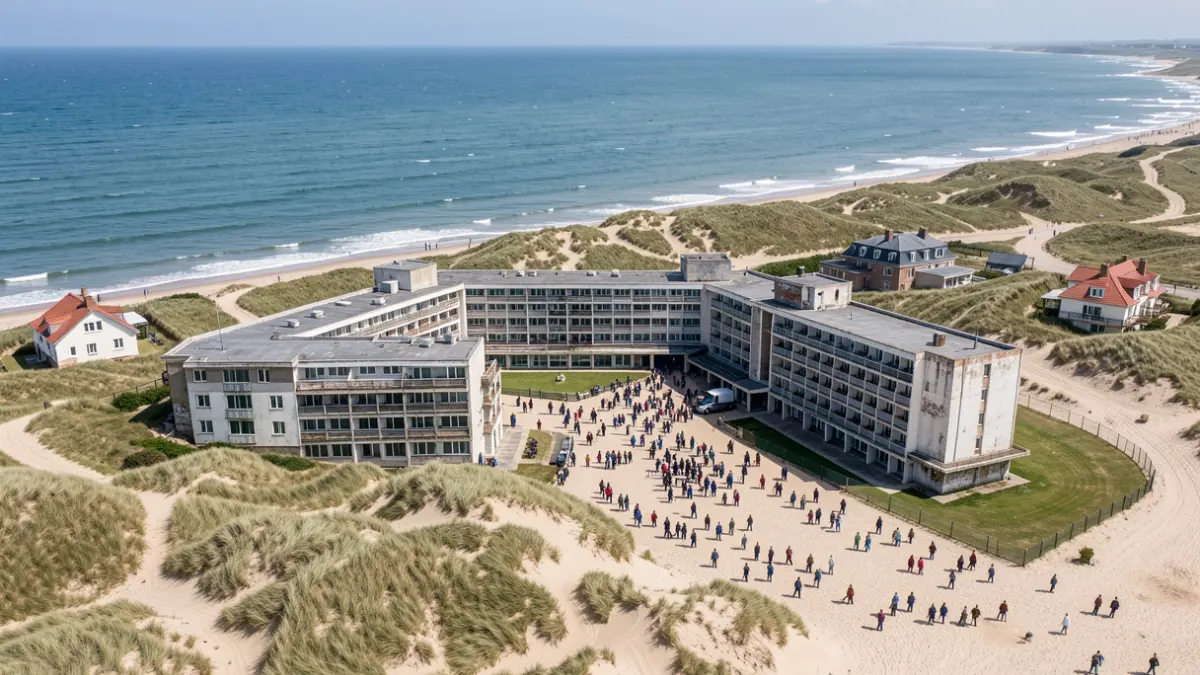
The Balearic chain RIU has presented a project to modernize and renovate one of its hotels in the Dunas de Corralejo, the Hotel RIU Palace Tres Islas. The company has submitted a document to the environmental body of the Cabildo of Fuerteventura for a simplified environmental impact assessment of the work, which includes the creation of six new rooms. This report justifies that the building is degrading due to its “exposure to sea spray” and proposes several actions to make it a “sustainability benchmark,” despite the controversy surrounding its location within a Natural Park and a coastal protection zone.
Environmental groups Turcón and Ben Magec have filed objections to the modernization project, which was made public, and insist that the reforms are “incompatible” with the protection of the public maritime-terrestrial domain and the high ecological value natural environment where the hotel is situated. Environmentalists believe the project contradicts “the principles of environmental sustainability and general interest that should govern administrative action”.
According to the modernization project document, the intervention is structured around four key areas: renovation of the air conditioning system to improve energy efficiency; structural safety, to reverse degradation from the environment and age; functional and accessibility modernization; and sustainability and efficient resource use, including the implementation of water-saving technologies. The project includes over 20 actions, such as creating six new rooms on the sixth floor, parking areas, replacing all elevators, renovating the reception lobby, creating a new solarium, a new fitness area, renovating one of the pools, and a SPA area adapted for people with reduced mobility. RIU maintains that the reform will act “exclusively” on the existing building.
RIU's environmental document analyzes the impact of the modernization works on the natural spaces crossed by the hotel and part of the Natura 2000 Network. Specifically, the project is developed on a cadastral plot affected by the Special Conservation Area (ZEC) Corralejo, the ZEC Sebadales de Corralejo, the Special Protection Area for Birds (ZEPA) Isla de Lobos, and the ZEPA Marine Area of La Bocayna. Among the birds identifiable in the area are the Cory's shearwater, European storm petrel, Bulwer's petrel, stone-curlew, Kentish plover, or the endangered Egyptian vulture. Regarding flora, the sea-lavender stands out, forming meadows of ecological interest for the Canary ecosystems and is included in the catalog of protected and vulnerable species.
RIU insists that “no significant effects on protected habitats are foreseen” and maintains that potential negative effects on the environment are “temporary, reversible, and of low magnitude,” mainly concentrated during the renovation phase. The chain considers the reform “imperative” to ensure structural safety and “environmental sustainability,” as well as to “improve the offering as a hotel service,” citing critical “technical and energy obsolescence” of the property.
Environmental groups Turcón and Ben Magec have filed objections to the project, urging the administration to “act firmly, in accordance with current legislation and in defense of the common good.” They have called for the effective completion of the demolition of the Oliva Beach hotel, the restoration of the occupied natural space, and the continuation of the concession expiry procedure for the Tres Islas hotel. For them, these hotels “have been a bad example of how to conduct a sustainable tourism policy,” by occupying “the environmental asset that serves as an attraction” and endangering citizens' right to use public domain.
Both this hotel and the Oliva Beach received a black flag from Ecologists in Action for environmental management. In July 2023, the General Directorate of Coasts initiated a new proceeding to declare the expiry of the concession granted to the Tres Islas hotel for occupying public domain, which was granted until 2037 under the condition of not modifying the height or surface area. Following unauthorized expansion works, a fine and an order to restore the property to its previous state were imposed. In 2021, a concession expiry proceeding was initiated, and in 2025, illegal suites on the rooftop were demolished, an action described by Turcón as an “aesthetic patch”.