
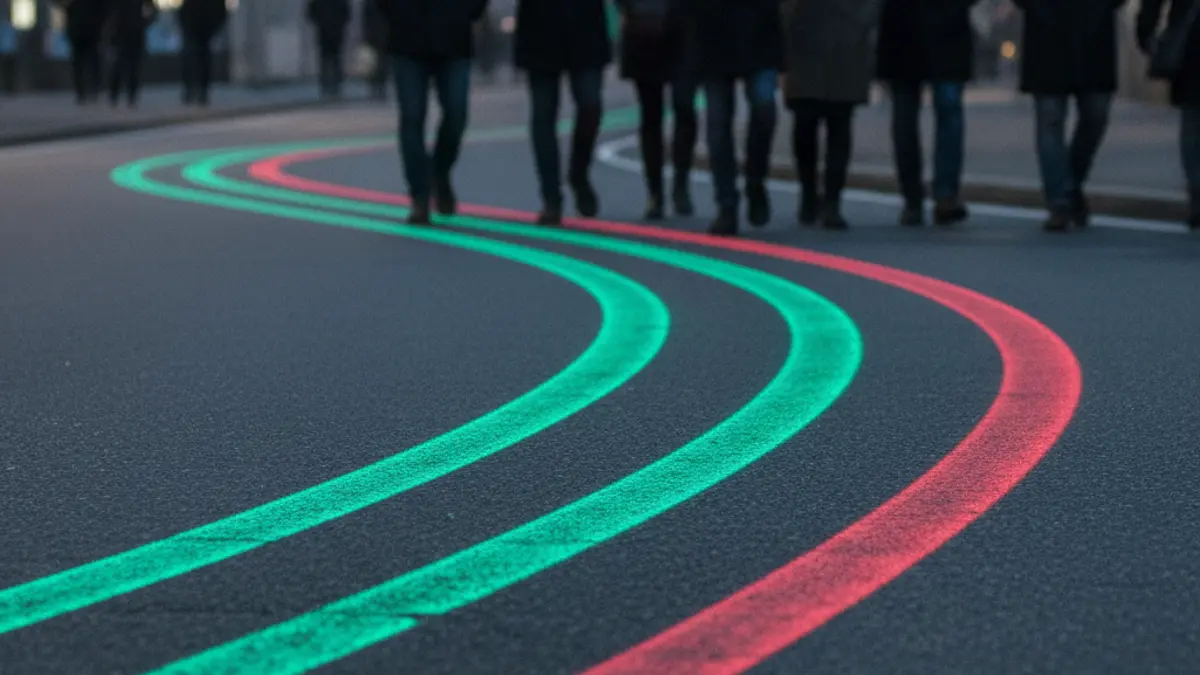
The research, carried out by scientific teams from the University of Granada (UGR), focused on the potential of smart road markings to improve road safety. These markings have the ability to emit light in the dark without the need for an external electrical source, storing light energy during the day and progressively releasing it at night.
Unlike conventional signage, which relies on vehicle headlight reflection, these lines allow drivers to better anticipate the road layout in low-visibility conditions. This advancement positions them as a key emerging technology in the development of smart roads.
To evaluate their impact, researchers designed an experiment using an advanced driving simulator at the UGR. Participants navigated nighttime scenarios replicating rural roads with curves, comparing conventional signage with smart green and red markings, and analyzing different line widths.
“"Furthermore, in no case was an increase in speed detected, suggesting that this technology improves road perception without inducing risky behaviors."
Preliminary results indicate that, with smart markings, drivers maintain a greater distance from the edge of the road, which is associated with a lower probability of lane departure. This positive effect was observed with both green and red markings, suggesting a general improvement in road visibility.
The study, published in the international journal Accident Analysis & Prevention, is part of the SARAH (Smart Road for Assisted Human Driving) project, funded by the Ministry of Science, Innovation and Universities, the State Research Agency, and FEDER funds from the European Union. Scientists note the need for future research in real-world environments to validate and expand these promising findings.