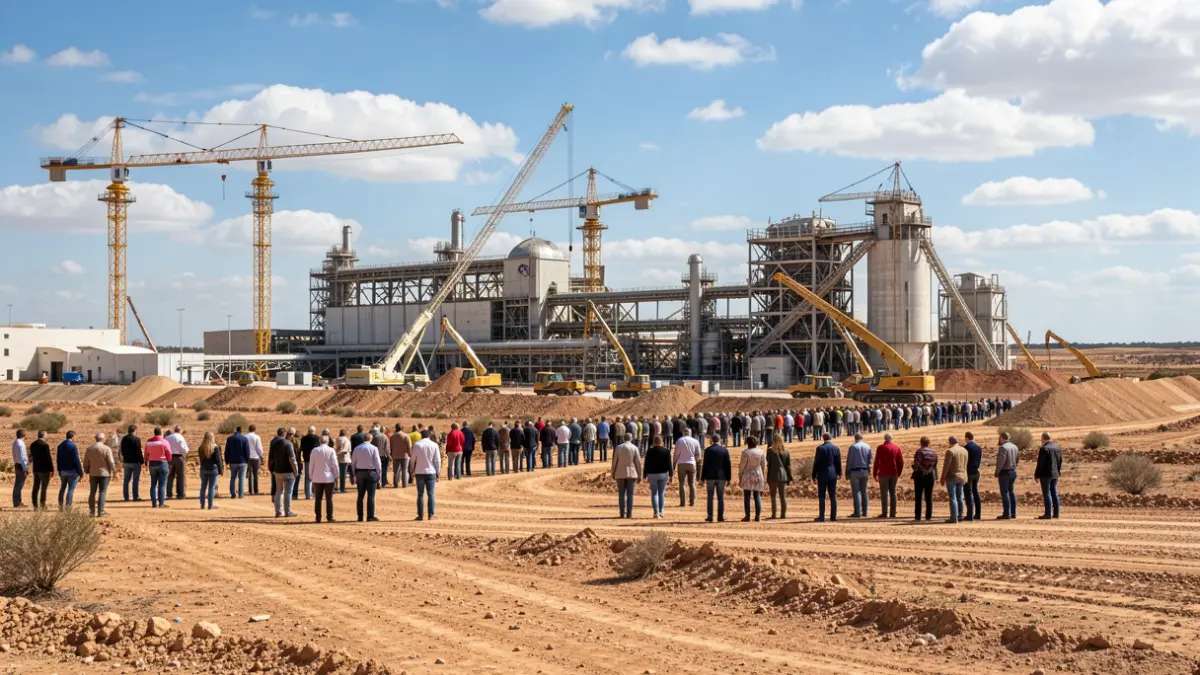
Energy company Moeve has laid the foundation stone for its Onuba plant, a 300-megawatt electrolysis facility located in Palos de la Frontera, Huelva. This milestone signifies the physical start of the first phase of the Andalusian Green Hydrogen Valley, recognized as one of Europe's most significant industrial projects for decarbonization.
The inauguration ceremony was attended by the President of the Government, Pedro Sánchez, and the President of the Regional Government of Andalusia, Juanma Moreno, highlighting the investment's economic and institutional importance. Also present were the Third Vice President and Minister for Ecological Transition, Sara Aagesen, and the Government Delegate in Andalusia, Pedro Fernández.
The Onuba plant, which will mobilize over 1 billion euros in industrial infrastructure and associated renewable generation, projects an impact of more than 8,000 direct and indirect jobs. It is expected to boost over 400 small and medium-sized enterprises and self-employed workers.
With an initial capacity of 300 MW, the facility, situated next to the Huelva energy park, aims to produce approximately 45,000 tons of renewable hydrogen annually and become operational in 2029. The project has received 263 million euros from the Recovery, Transformation, and Resilience Plan.
Onuba serves as the first component of the Andalusian Green Hydrogen Valley, whose overall design aims to achieve two gigawatts of electrolysis, split between Palos de la Frontera and San Roque (Cádiz). The complete project, with an investment close to 3 billion euros, is anticipated to generate around 10,000 jobs.
The hydrogen produced will initially be used to reduce emissions within Moeve's industrial processes and those of its clients, and will serve as a feedstock for sustainable fuels in heavy transport, shipping, and aviation. It is estimated that the entire Valley could prevent the emission of up to six million tons of CO2 annually.
The plant will be integrated into the ongoing transformation of the Energy Park La Rábida, where Moeve is already constructing a second-generation biofuel plant and developing a new isopropyl alcohol factory. The future availability of green hydrogen will enable the production of synthetic fuels and reduce the use of fossil-based raw materials.
Moeve's CEO, Maarten Wetselaar, emphasized the importance of creating conditions for projects of this scale and called for greater ambition to meet decarbonization goals and enhance European energy independence, despite progress with the RED III directive.
The scale of Onuba and its connection to existing industrial demand mitigate the risk of finding stable buyers for hydrogen. The proximity of the ports of Huelva and Algeciras will facilitate connection with international routes and future exports, supported by agreements such as the maritime corridor with the Port of Rotterdam.